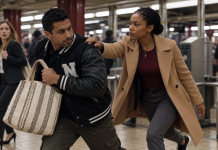
Sienna was twenty floors above the city when someone struck her from behind.
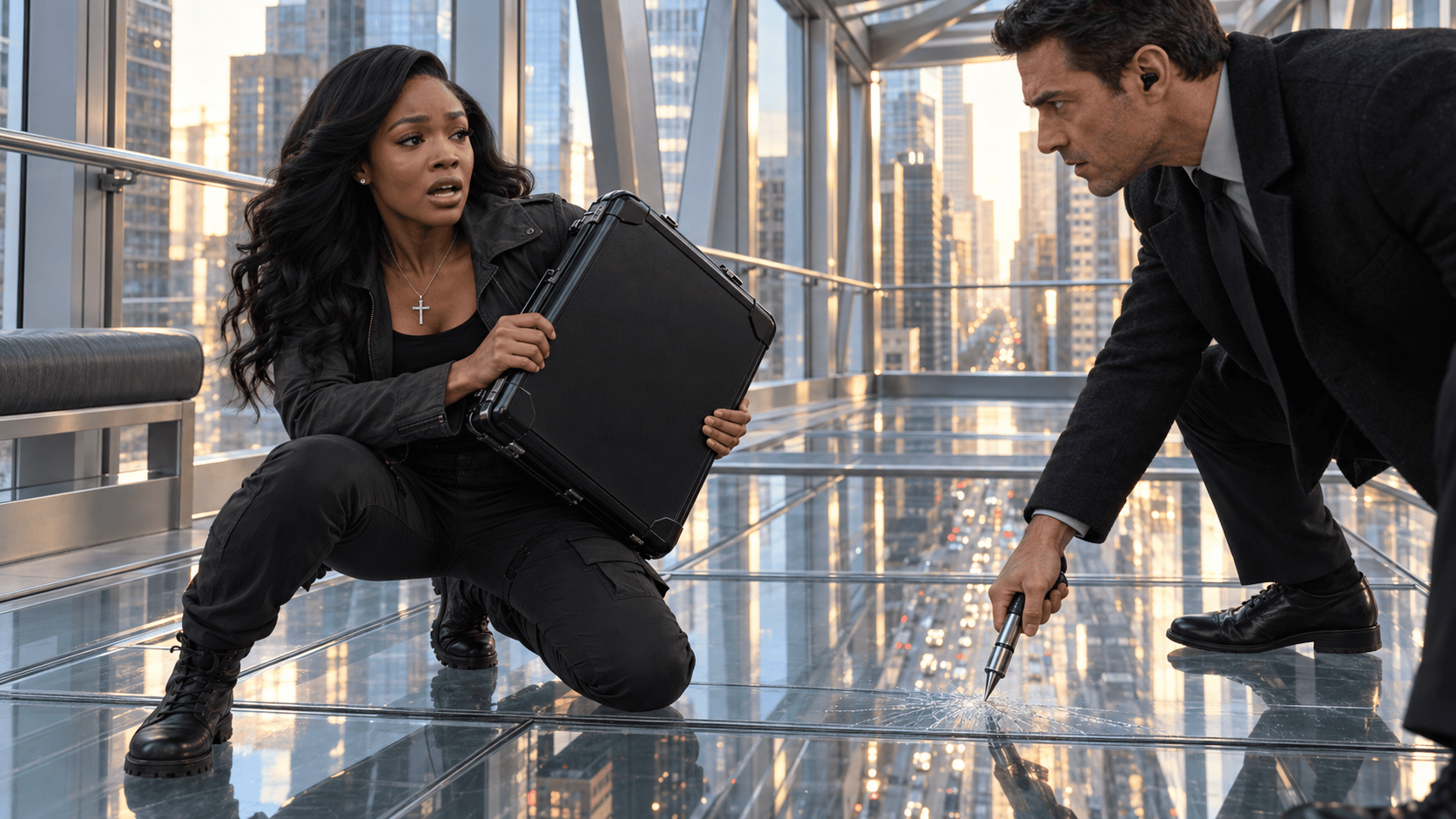
She crashed shoulder-first into the glass wall of the enclosed skybridge connecting two office towers. Traffic moved far below her as a man in a charcoal suit pulled a steel glass-breaking tool from his coat.
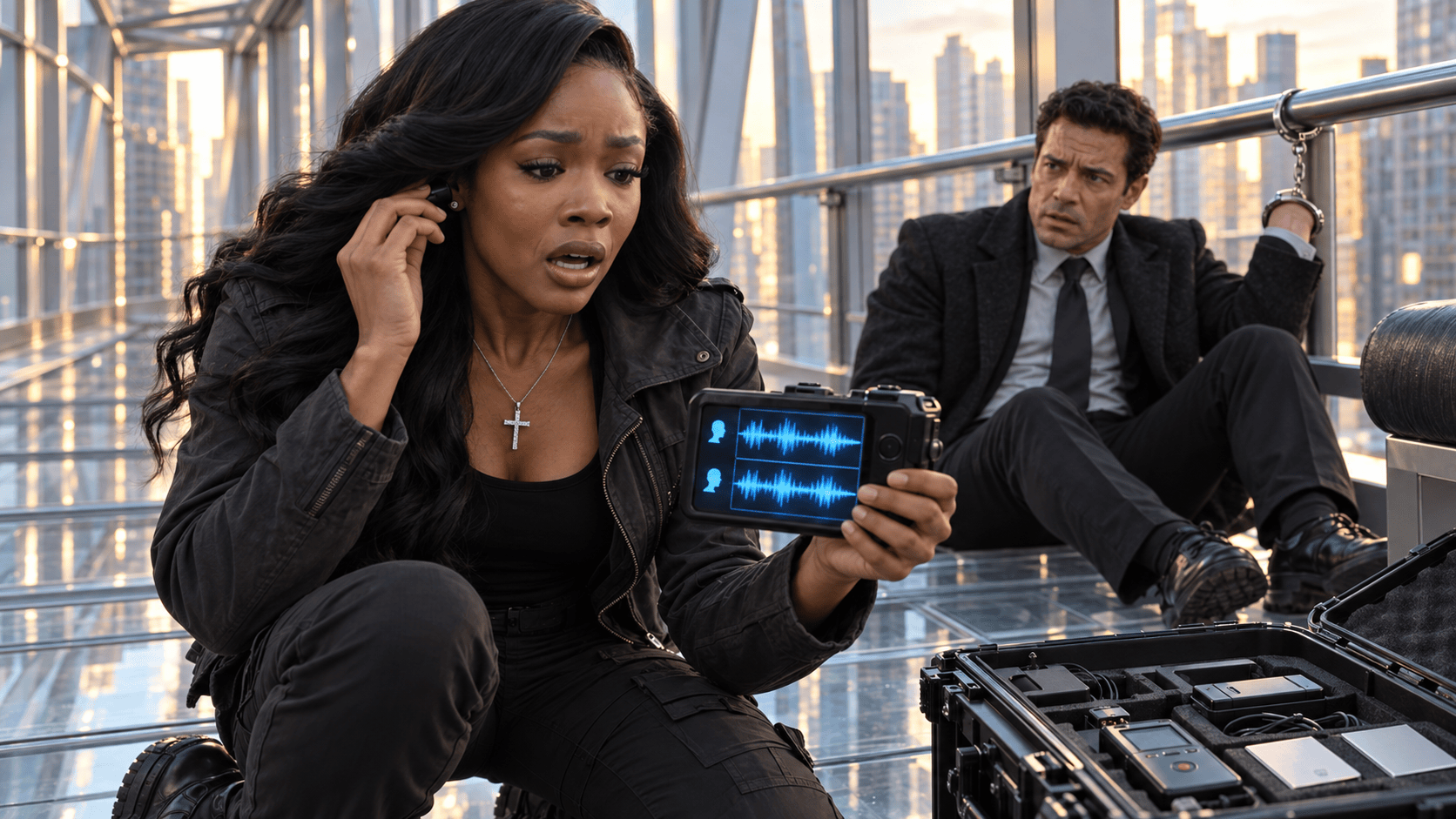
He did not ask for her weapon, identification or money.
He attacked the floor beneath her feet.
The first strike created a web of cracks in the upper layer of the glass. Sienna moved just before the second impact landed where her leg had been.
She grabbed the man’s reinforced briefcase and raised it as a shield. His next strike dented its metal corner instead of hitting her shoulder.
The fight moved across the narrow bridge. Sienna blocked a punch, trapped his weapon arm with the briefcase strap and used the fixed bench to throw him off balance.
Seconds later, his wrist was handcuffed to the metal railing.
That should have ended the attack.
Instead, a small black earpiece fell from his right ear and landed on the glass.
A woman’s voice was still speaking through it.
“Do not let me reach the meeting.”
Sienna froze.
The voice was hers.
It had her exact tone, breathing pattern and rhythm. Even the slight pause before the word “meeting” sounded like her.
But Sienna had never spoken those words.
The restrained attacker looked just as confused.
“You called me,” he insisted. “You said someone had copied your face. You said the woman crossing the bridge wasn’t really you.”
The message had included Sienna’s photograph, route and confidential identification phrase. It had also arrived through an authenticated agency channel.
The man had not believed he was attacking Sienna.
He believed he was protecting the real Sienna from an impostor.
Inside his briefcase, she found a compact communication relay and recordings of seven previous instructions. Every command used her voice.
One had redirected an armed response team away from a protected witness. Another canceled surveillance on a suspected traitor. A third authorized the transfer of classified evidence to an unknown courier.
All seven commands had passed voice authentication.
Sienna continued toward the meeting she had nearly been prevented from reaching. When she entered the conference room, the chairs were empty and the main screen was still active.
A blue waveform appeared beside her name.
VOICE MODEL: SIENNA WILLIAMS
AUTHENTICATION MATCH: 99.98%
The files led to a classified system known as Project Chorus.
The program had originally been created to reproduce an agent’s voice during hostage situations when direct communication was impossible. Sienna’s model had been trained secretly using years of recorded interviews, phone calls, interrogations and operational briefings.
Only three people had permission to access it.
One of them, Dr. Mara Keene, had disappeared that morning.
Keene directed the agency’s communications laboratory. She had quietly copied Sienna’s voice model and connected it to a stolen authorization key, allowing fabricated commands to sound authentic and pass the agency’s security system.
But Keene could not have stolen that key alone.
The access logs showed that someone with executive-level clearance had approved every command.
Sienna discovered that seventeen separate orders had already been issued in her name. Agents had changed positions, evidence had been relocated and two protected witnesses had vanished—all because teams believed Sienna had personally instructed them.
Then an eighteenth command appeared on the screen.
It had been scheduled to transmit at midnight to every field office in the country:
“Agent Sienna Williams has been compromised. Detain her immediately. Use force if she resists.”
Whoever stole her voice was not only sabotaging her missions.
They were preparing to make the entire agency hunt her.
As Sienna attempted to cancel the command, the conference-room speakers activated.
Her own voice calmly said:
“You’re already too late.”