Elijah Brooks found the wallet lying near a shopping cart outside the supermarket.
The 68-year-old homeless veteran opened it just far enough to see an identification card and several hundred dollars in cash. He removed nothing.
Instead, Elijah entered the store and approached the customer-service counter with the wallet held openly in both hands.
“I found this outside. I’m trying to return it,” he explained.
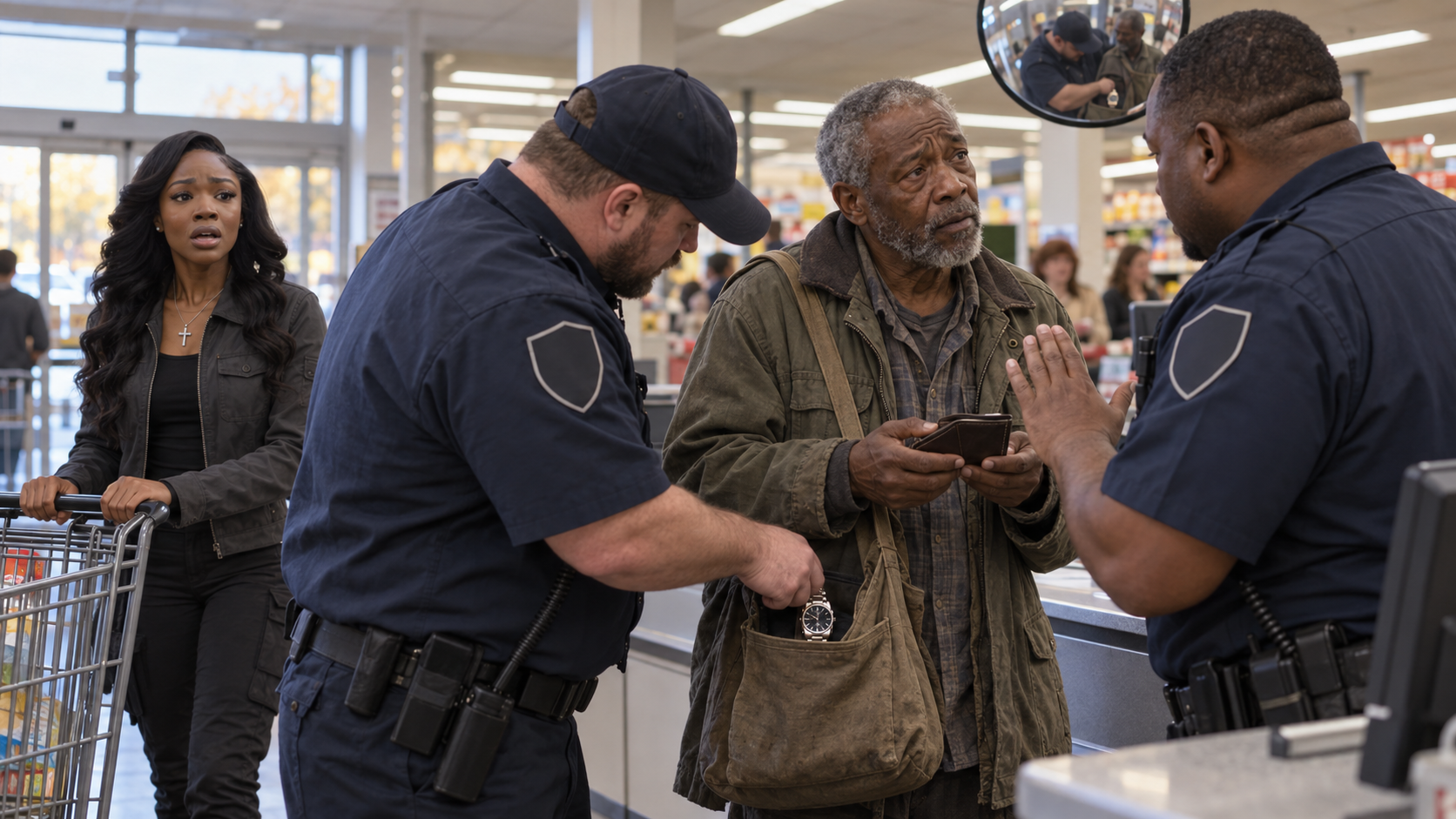
Before the employee could answer, two security guards surrounded him.
One grabbed his arm and ordered him to put the wallet down. The other blocked his path while frightened customers began gathering around them.
Elijah immediately raised his empty hands.
“I didn’t steal anything.”
Nobody appeared to believe him.
Sienna was standing near the checkout lanes when the guards forced Elijah onto one knee. At first, the incident looked like an aggressive misunderstanding.
Then she looked into the convex security mirror above the registers.
While one guard distracted Elijah, the other removed an expensive wristwatch from his own pocket and slipped it into Elijah’s canvas bag.
Sienna walked toward them.
“Take your hand out of his bag.”
The guard, whose name was Carl Denton, froze. His partner looked at him in confusion.
Denton told Sienna to leave, but she pointed toward the security cameras. Realizing that she had witnessed everything, he activated the emergency lock and sealed the store’s glass exit doors.
Then he attacked her.
Denton drove Sienna backward into a row of shopping carts. One cart broke loose and crashed across the checkout lane, narrowly missing several customers.
When Denton charged again, Sienna redirected his momentum toward an empty cardboard display. The boxes collapsed beneath him, and seconds later she had him pinned to the floor.
But proving Elijah’s innocence was only the beginning.
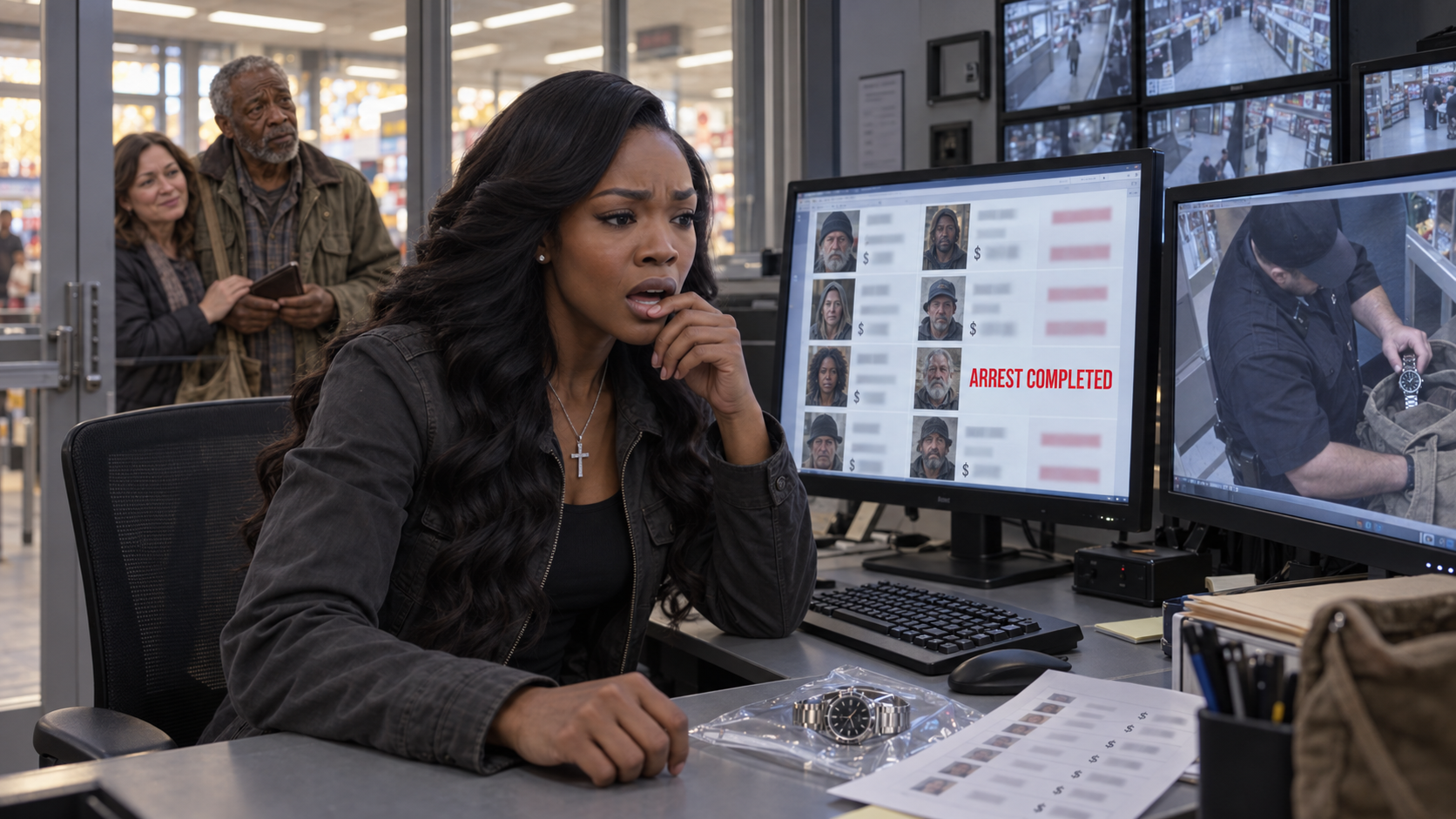
Using Denton’s security card, Sienna entered the store’s monitoring office and rewound the footage. The recordings showed Elijah finding the wallet, checking the identification and walking directly inside.
They also showed Denton taking the watch from his own pocket.
Sienna displayed the footage on a monitor facing the gathered customers.
The store fell silent.
Elijah had entered the building to return hundreds of dollars to a stranger. In exchange, he had been humiliated, assaulted and nearly arrested for a crime manufactured in front of dozens of people.
While copying the footage, Sienna noticed a hidden folder on the security computer.
Inside were photographs of homeless people from across the city.
Some had been photographed sleeping beneath bridges. Others were captured outside shelters, soup kitchens and subway stations. Beside every photograph was a neighborhood code, a dollar amount and a status.
Most of them read:
“ARREST COMPLETED.”
Elijah’s photograph was there too.
His file included his usual sleeping location, the church where he received meals and the supermarket he visited each afternoon. The payment beside his name was $1,200.
This had not been Denton’s first false accusation.
The records showed that the security company received bonuses whenever a targeted homeless person was arrested or forced to leave one of six designated neighborhoods. Guards planted watches, wallets and small electronics, then used their uniforms and edited security footage to make the accusations appear legitimate.
All six neighborhoods had something else in common.
They surrounded properties scheduled for luxury redevelopment.
The payments were routed through a nonprofit organization called the Clean Horizon Initiative, which claimed to finance neighborhood safety programs. In reality, the organization was controlled by Halcyon Development Group and its chief executive, Adrian Voss.
Voss wanted the streets around his future apartments cleared before investors arrived. Rather than waiting for the city to relocate the homeless population legally, his company paid private security guards for every successful “removal.”
Several people on the list had spent months in jail awaiting hearings because they could not afford bail. Others had disappeared from the area entirely.
Elijah had been selected because the guards believed nobody would defend a homeless man.
They were wrong.
Denton was arrested, the original security footage was preserved and Elijah’s record was cleared before charges could be filed. The investigation eventually connected the payment system to dozens of fabricated thefts.
But the final file on the computer was different from all the others.
It contained a recent photograph of Sienna standing outside the supermarket.
Beside her name was a payment of $50,000 and a new status:
“INTERFERENCE RISK—REMOVAL PENDING.”
Someone had known she would be there.
And after she exposed the operation, the people funding it were no longer targeting only the homeless.