Turmeric has one of the healthiest reputations in the supplement aisle. It is added to smoothies, brewed into golden milk and sold in capsules promising support for joints, inflammation, the brain, the heart and almost everything in between. That familiarity can make a daily capsule feel as ordinary as seasoning dinner. It is not always that simple.

The National Center for Complementary and Integrative Health says there is not enough evidence to definitively conclude that turmeric or curcumin is beneficial for any health purpose. Some early findings are encouraging, especially in areas such as knee osteoarthritis, but the products used in studies vary widely. At the same time, highly bioavailable curcumin formulations have been linked to liver injury in a small number of people. Before turning turmeric into a permanent daily habit, these seven points deserve attention.
The first distinction to make
| Question | Turmeric in food | Curcumin supplement |
| Concentration | Usually modest and spread through a meal | Often standardized or concentrated |
| Absorption | Naturally limited | May include piperine or special delivery technology |
| Research match | Culinary use is rarely equal to a trial product | Depends on the exact extract and formulation |
| Risk picture | Normal food amounts are generally familiar | Higher exposure can mean different side effects and interactions |
1 A spice and a capsule are not equivalent
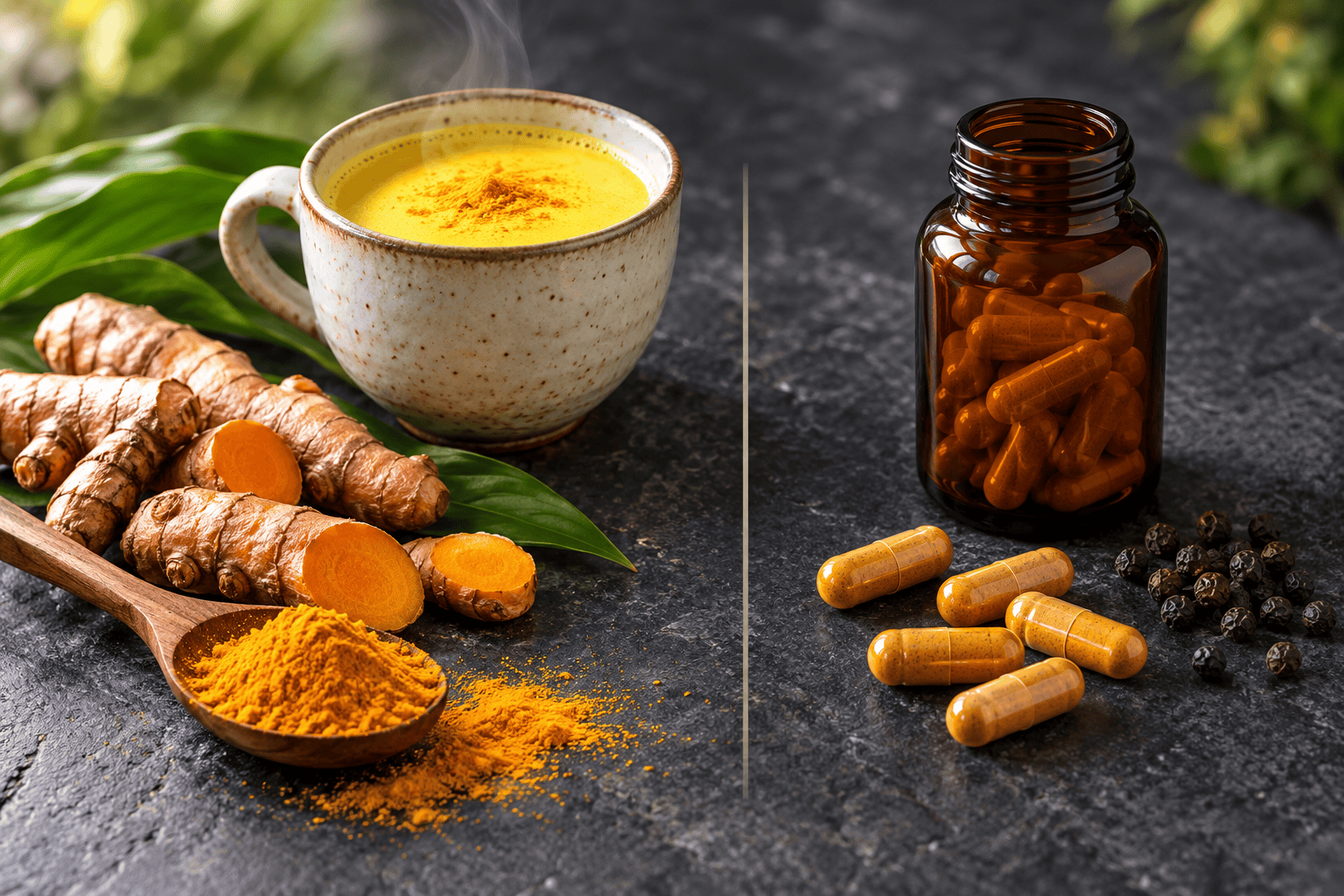
A spoonful of turmeric powder in a pot of food is very different from a capsule designed to deliver a concentrated amount of curcuminoids. Curcumin is one of turmeric’s best-known compounds, but it makes up only part of the whole spice. Supplement labels may list turmeric powder, turmeric extract, curcuminoids, curcumin or a combination of these. Those words do not describe identical products.
This matters because a benefit or side effect observed with one standardized extract cannot automatically be assigned to every turmeric tea, spice blend or capsule. When someone says that ‘turmeric was studied,’ the first useful question is what exact preparation was used.
2 The evidence is interesting but not definitive
Turmeric has been studied for many conditions, but the overall picture remains uncertain. NCCIH reports that several analyses of oral turmeric or curcumin for knee osteoarthritis found positive initial evidence for pain, stiffness and function. Higher-quality studies are still needed, and researchers do not yet fully understand how different formulations and absorption levels affect the result.
Early research has also examined nonalcoholic fatty liver disease and other conditions, but that does not justify broad claims that a daily capsule prevents disease or works like a medication. A laboratory mechanism, a small trial and a proven clinical benefit are three different levels of evidence. Marketing often presents them as if they were the same.
3 Better absorption is not automatically better
Curcumin is naturally absorbed poorly. To overcome that, manufacturers may add piperine from black pepper or use special formulations intended to increase bioavailability. This can make more curcumin available to the body, which sounds like an uncomplicated advantage. It also changes the exposure and potentially the safety profile.
NCCIH specifically notes that highly bioavailable curcumin formulations may harm the liver and that products differ in how much curcumin they contain and which additional plant substances they include. A label that says ‘enhanced absorption,’ ‘high bioavailability’ or lists black pepper extract deserves more attention, not less.
4 Daily use does not mean indefinite use
There is no universal daily turmeric dose that is appropriate for every person and every purpose. NCCIH says conventionally formulated oral turmeric or curcumin is likely safe in recommended amounts for up to two or three months. That statement does not establish that every concentrated product is safe to take every day for years.
If a person chooses to use a supplement, the dose and duration should match a specific reason rather than becoming an automatic habit. Reassessing whether it is helping, whether the formulation has changed and whether new medications have been added is more sensible than assuming that a familiar plant can be taken indefinitely without review.
5 Stomach symptoms are common and liver warning signs matter
Oral turmeric can cause nausea, vomiting, acid reflux, stomach upset, diarrhea or constipation. These effects may be dismissed because the product is natural, but repeated discomfort is still a reason to reconsider the product, dose or timing.
Liver injury appears to be uncommon, but it is important enough to recognize. NCCIH advises people to stop turmeric or curcumin products and speak with a health care provider if symptoms such as unusual fatigue, nausea, poor appetite, dark urine or yellowing of the skin or eyes develop. LiverTox, a National Library of Medicine resource, also documents cases of clinically apparent liver injury associated with turmeric and curcumin products.
6 Medicines pregnancy and surgery change the decision
A supplement does not exist in isolation. FDA guidance warns that dietary supplements can alter the absorption, metabolism or excretion of medicines, interfere with laboratory tests and create problems around surgery. Anyone taking prescription or over-the-counter medication should discuss a new daily turmeric or curcumin product with a clinician or pharmacist who can review the full list.
NCCIH says turmeric supplements during pregnancy may be unsafe, and little is known about amounts greater than those normally found in food while breastfeeding. The FDA also advises people planning surgery to disclose all supplements because some may need to be stopped in advance. Culinary use and concentrated supplementation should not be treated as the same question in these situations.
7 The front label is marketing and the facts panel is information
Words such as premium, advanced, maximum strength and natural do not tell you whether a product was effective in a clinical trial. Look for the amount per serving, the form of turmeric or curcumin, serving size, additional ingredients and any absorption enhancer. If the label hides the amounts inside a proprietary blend, comparison becomes harder.
The FDA does not approve dietary supplements for safety and effectiveness before they are sold. Manufacturers are responsible for safety and labeling, while FDA oversight largely begins after products reach the market. Independent quality verification can offer additional information about manufacturing and contents, but it does not prove that the supplement will deliver the advertised health benefit.
A practical checklist before the next capsule
• Do I know whether this is turmeric powder, a standardized extract or isolated curcumin?
• How much am I taking per serving, and how many servings am I taking each day?
• Does it contain black pepper extract or another absorption enhancer?
• Am I taking it for a specific, realistic reason that can be reassessed?
• Have I reviewed it against my medicines, health conditions and upcoming procedures?
• Have I developed stomach symptoms, unusual fatigue, dark urine or yellowing of the skin or eyes?
• Can the manufacturer clearly explain product testing and the amount of each active ingredient?
The bottom line
Turmeric can be a flavorful part of food, and curcumin remains a legitimate subject of research. Neither fact makes every daily capsule necessary, effective or risk-free. The biggest mistake is assuming that a concentrated, absorption-enhanced supplement is simply the spice rack in a more convenient form.
If you use turmeric or curcumin every day, know the exact product, dose, formulation and reason. Treat new symptoms seriously, review possible interactions and do not let a supplement replace appropriate medical care. The goal is not to fear turmeric. It is to use the same judgment for a familiar herb that you would use for any substance designed to have an effect in the body.
This article is for general education and is not a diagnosis or treatment plan. Supplements can cause side effects and interact with medicines. Readers who take regular medication, are pregnant or breastfeeding, have liver concerns, are preparing for surgery or develop concerning symptoms should seek advice from a qualified health professional.