
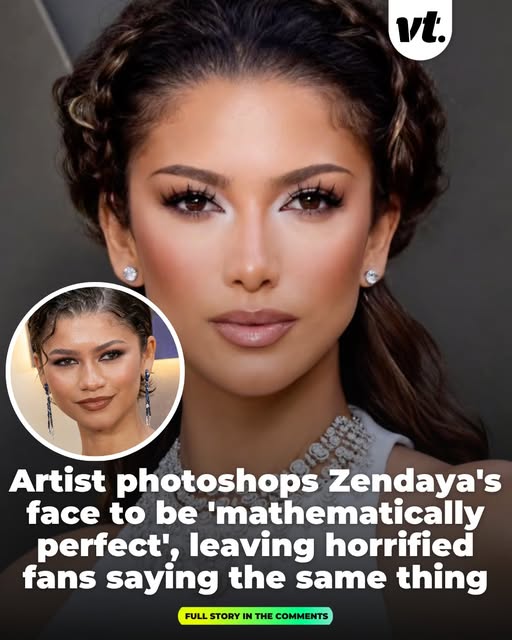
Zendaya has long been admired for her natural beauty, effortless style, and distinctive features, making her one of Hollywood’s most recognizable stars. Recently, however, a digital artist sparked an online debate after editing her face to fit what is often described as the “mathematical ideal” of beauty.
The experiment was intended to demonstrate how facial proportions could be altered to more closely match the so-called Golden Ratio—a mathematical formula that has been linked to beauty for centuries. Instead of impressing viewers, the edited image left many social media users unsettled, with countless fans saying the same thing: Zendaya looked better before the changes.
The Experiment Behind the Viral Image
The artist used digital editing software to adjust Zendaya’s facial proportions according to measurements associated with facial symmetry and the Golden Ratio. Small changes were made to the width of her nose, the placement of her eyes, the shape of her lips, and the balance of her jawline. At first glance, the differences appeared subtle. However, when the original and edited versions were placed side by side, the alterations became much more noticeable. The transformed image presented a face that was technically more symmetrical but lacked many of the unique characteristics that make Zendaya instantly recognizable. The comparison quickly spread across social media platforms, where users began discussing whether mathematical precision could truly define attractiveness.

Fans React With Surprise
Thousands of people commented on the edited image, and while reactions varied, many shared a similar opinion. Rather than describing the altered version as more beautiful, users said it looked unusual, overly artificial, or simply “off.” Others remarked that the changes removed much of Zendaya’s individuality, making her resemble a computer-generated character instead of a real person. Some viewers pointed out that her natural features contribute to her charm, arguing that slight imperfections are often what make someone memorable. Others questioned why someone widely regarded as one of the world’s most beautiful celebrities would need to be digitally “improved” at all. The overwhelming response highlighted a growing skepticism toward beauty filters and digitally altered images that prioritize unrealistic standards over authenticity.
Does Mathematical Perfection Equal Beauty?
The Golden Ratio has fascinated artists, architects, and scientists for centuries. Often represented by the number 1.618, it has been found in nature, famous works of art, and architectural landmarks. Some researchers have suggested that faces with proportions closer to this ratio may be perceived as more attractive. However, many psychologists and beauty experts caution against treating the formula as a universal definition of beauty. Human attraction is influenced by countless factors beyond symmetry, including facial expressions, personality, confidence, uniqueness, and cultural preferences. A perfectly balanced face on paper does not necessarily create a stronger emotional connection in real life.
Why Imperfections Matter
Experts frequently note that minor facial asymmetries make people appear more human and expressive. In fact, nearly everyone has slight differences between the left and right sides of their face. These natural variations often go unnoticed during everyday interactions but become obvious when digitally removed. As a result, perfectly symmetrical faces can sometimes appear unnatural because the brain is accustomed to seeing subtle imperfections. This may explain why many people reacted negatively to the edited image of Zendaya despite its mathematically balanced proportions.
A Reminder That Beauty Is More Than Numbers
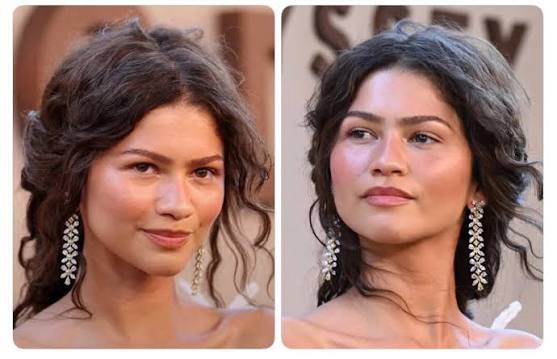
The viral discussion surrounding Zendaya’s photo has reignited conversations about modern beauty standards and the growing influence of digital editing tools. While technology makes it easier than ever to reshape faces with remarkable precision, the public response suggests that many people still value authenticity over perfection. For many fans, the experiment demonstrated that beauty cannot be reduced to mathematical formulas alone. Zendaya’s original appearance, with all of its distinctive features and natural balance, was widely viewed as more appealing than the digitally perfected version. Ultimately, the debate serves as a reminder that individuality often leaves a stronger impression than symmetry. What makes someone truly attractive is rarely a precise set of measurements—it is the combination of personality, confidence, and unique features that no editing software can accurately recreate.