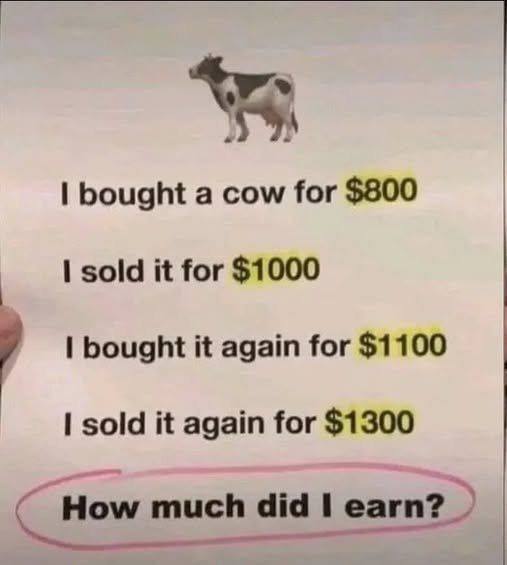
A simple-looking math puzzle about buying and selling a cow has taken the internet by storm, leaving many people scratching their heads. At first glance, it appears to be an easy calculation, but the way the information is presented often leads to confusion. That’s exactly what makes it so engaging and so widely shared.
The puzzle typically goes like this:
You buy a cow for $800
You sell it for $1,000
Then you buy it again for $1,100
Finally, you sell it for $1,300
The question is straightforward: How much profit did you make in total?
Why It Confuses So Many People
Despite its simplicity, this puzzle tricks people into overthinking. Many assume there must be a hidden catch or complicated formula involved. Others try to combine all transactions at once, which often leads to incorrect answers. A common mistake is believing that the second purchase somehow cancels out the profit made from the first sale. This misunderstanding causes people to arrive at answers like $200 or even $0. The real issue isn’t the math—it’s how the brain processes multiple steps at once.
This puzzle highlights how easily we can lose track of basic logic when information is presented in a slightly complex way.
Breaking It Down Step by Step
The easiest way to solve the problem is to treat each transaction separately. Instead of trying to calculate everything at once, focus on one buy-and-sell cycle at a time.
First transaction:
You buy the cow for $800
You sell it for $1,000
Profit: $200
Second transaction:
You buy the cow again for $1,100
You sell it for $1,300
Profit: $200
Now simply add the profits from both transactions:
$200 + $200 = $400 total profit
By isolating each step, the solution becomes clear and easy to follow.
Another Way to Look at It
If you prefer a broader perspective, you can also calculate the total money spent and earned.
Total spent: $800 + $1,100 = $1,900
Total earned: $1,000 + $1,300 = $2,300
Now subtract:
$2,300 − $1,900 = $400 profit
This method confirms the same answer and may feel more intuitive for some people.
Why the Puzzle Goes Viral
The cow math puzzle spreads quickly online because it challenges intuition. People enjoy testing themselves and comparing answers with others. When they realize they got it wrong, they are even more likely to share it. It also sparks debate. Friends, family, and social media users often argue over the correct answer, each convinced they are right. This interaction keeps the puzzle circulating and engaging new audiences.
The Lesson Behind the Puzzle
Beyond entertainment, the puzzle teaches an important lesson: breaking problems into smaller parts makes them easier to solve. When faced with multiple steps, focusing on one piece at a time prevents confusion and errors. It also shows how our brains can complicate simple situations. By staying organized and thinking logically, even tricky-looking problems become manageable.
Final Answer
After carefully analyzing each step, the correct answer is clear:
You made a total profit of $400
Final Thought
What makes this puzzle so fascinating is not the math itself, but how it reveals the way we think. A problem that looks complicated at first turns out to be surprisingly simple once approached correctly. And that’s exactly why it continues to puzzle—and entertain—people all over the world.