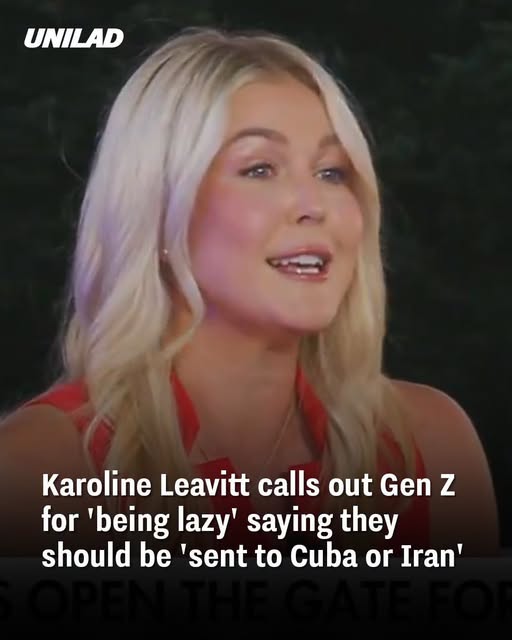
White House Press Secretary Karoline Leavitt has sparked a wave of online debate after making a controversial remark suggesting that members of Generation Z who criticize the United States should spend time living in countries such as Cuba or Iran. Her comments quickly spread across social media, drawing strong reactions from supporters and critics alike. While some agreed with her message about appreciating life in America, others argued that the statement oversimplified complex political issues and unfairly targeted younger generations.
The Comment That Went Viral
Leavitt made the remarks while discussing criticism of the United States from some younger Americans. She argued that people who believe America is one of the worst places to live should experience life under governments that offer fewer political freedoms and economic opportunities. She specifically mentioned Cuba and Iran as examples of countries where daily life is significantly different from that in the United States. The comments immediately gained traction online, with clips circulating across multiple social media platforms and generating thousands of reactions within hours.
A Divided Response
Supporters praised Leavitt’s statement, saying it highlighted freedoms and opportunities that many Americans may take for granted. Some argued that comparing the United States with countries facing political repression, strict government controls, or economic hardship provides useful perspective for people who regularly criticize American society. Others believed her comments reflected a broader frustration among conservatives regarding anti-American sentiment expressed by some younger voters. However, critics viewed the remarks differently. Many argued that patriotism and criticism are not mutually exclusive, pointing out that people can value their country while also calling for reforms and improvements. Others felt singling out Generation Z ignored the diversity of opinions within the age group.
Why Generation Z Is Often at the Center of Political Debate
Generation Z, generally defined as people born between the late 1990s and early 2010s, has become one of the most politically active age groups in recent years. Surveys have shown that younger voters often prioritize issues such as climate change, healthcare, education costs, social justice, and economic inequality. These priorities sometimes place them at odds with older generations and political leaders from both major parties. As a result, debates involving Gen Z frequently become flashpoints in wider national conversations about politics, identity, and the future direction of the country.
Cuba and Iran in the Discussion
Leavitt’s reference to Cuba and Iran was intended to contrast life in the United States with nations that have faced longstanding political and economic challenges. Cuba continues to experience economic difficulties, shortages of basic goods, and restrictions on political opposition, while Iran has faced international sanctions, economic pressures, and criticism over limits on civil liberties and human rights. Her supporters argued that these comparisons reinforce the value of democratic institutions and individual freedoms in the United States. Critics, however, said such comparisons oversimplify the reasons why young Americans express dissatisfaction with aspects of life in their own country.
Social Media Fuels the Conversation
As with many political moments, social media amplified the discussion almost immediately. Supporters shared clips of Leavitt’s comments alongside messages praising American values and encouraging greater appreciation for life in the United States. Meanwhile, opponents responded by emphasizing that constructive criticism is an important part of democracy and that questioning government policies does not necessarily mean rejecting one’s country. The debate soon expanded beyond Leavitt’s original remarks, becoming part of a larger conversation about patriotism, free speech, and generational differences.

A Continuing Political Flashpoint
Leavitt’s comments illustrate how discussions about national identity and political values continue to resonate across the United States. Whether viewed as a defense of American freedoms or an unnecessarily divisive statement, the remarks have once again highlighted the growing political influence of Generation Z and the ongoing debate over how younger Americans view their country. With social media ensuring that political soundbites travel faster than ever, conversations like this are likely to remain at the center of public attention long after the original remarks were made.