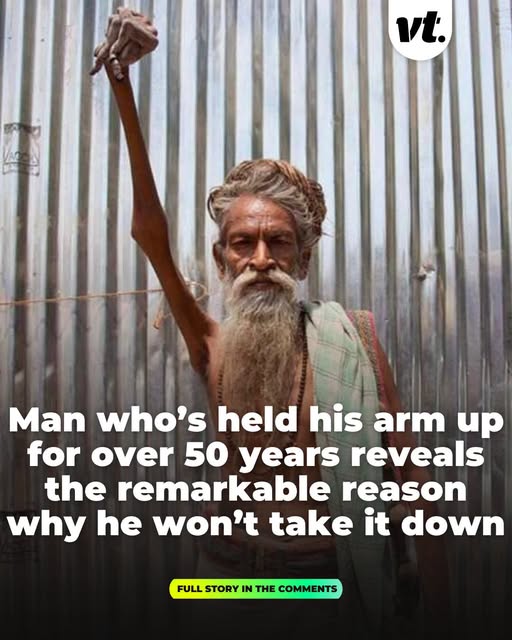
For more than five decades, an Indian ascetic named Amar Bharati has reportedly kept his right arm raised above his head. What began in 1973 as a personal act of religious devotion eventually became one of the most unusual examples of extreme asceticism known around the world. Bharati reportedly chose to abandon his previous life, including his work and family, and dedicate himself to Lord Shiva and the idea of promoting peace.
His decision was not intended simply to attract attention. According to accounts of his life, he wanted the raised hand to represent his devotion and his wish for people to live without war, hatred and violence.
The First Years Were Extremely Painful
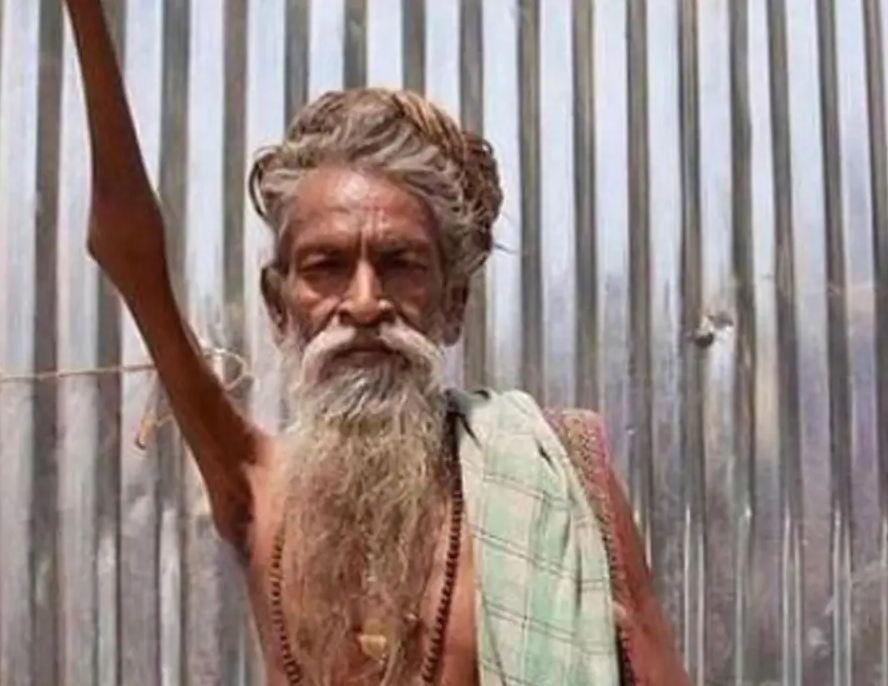
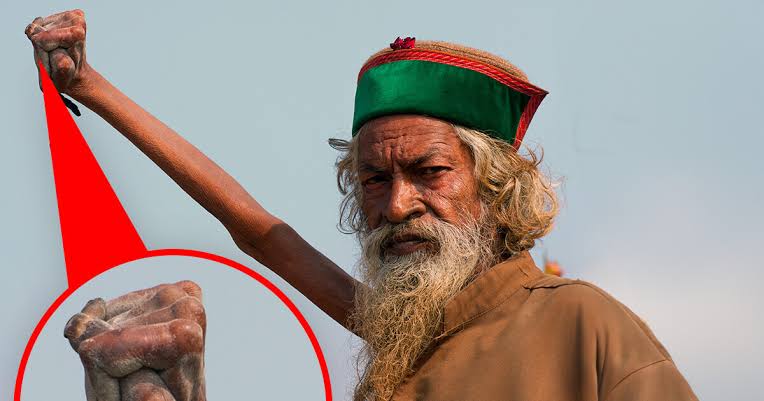
Keeping an arm permanently elevated is far from an easy physical challenge. During the first years, Bharati reportedly experienced severe and persistent pain. Eventually, however, the sensation in his arm disappeared and the limb underwent dramatic physical changes. Accounts state that the muscles in his raised arm gradually atrophied after remaining in the same position for such a long period. The arm became thin and permanently altered, making his unusual commitment visible even from a distance. Although people sometimes assume that the arm is simply being held up by strength or willpower, decades of immobility can fundamentally change muscles, joints and connective tissues. This is one reason the story is as much about the physical consequences of extreme immobility as it is about spirituality.
Why Did He Choose to Do It?
Bharati was reportedly a married man with three children and worked at a local bank before leaving his former life in the early 1970s. He then became an ascetic and devoted himself to Shiva. His raised hand was intended as a symbol of his religious commitment and his desire for world peace. In accounts attributed to Bharati, he questioned why people fight and expressed a wish for people in India and around the world to live peacefully with one another. For him, the physical suffering was part of a much larger spiritual purpose. Extreme acts of self-discipline have a long history within certain ascetic traditions, where enduring physical hardship can be viewed as a way of demonstrating dedication and distancing oneself from ordinary material life.
What Happened to His Arm?
The most striking part of the story is what decades of keeping the arm elevated appear to have done to his body. Reports say that Bharati eventually lost sensation in the limb and that significant muscle wasting occurred. Some accounts have also claimed that his elbow and surrounding tissues became severely restricted after remaining in the same position for so many years. However, some of the more dramatic claims surrounding his arm are difficult to independently verify. Stories suggesting that his bones have completely fused or that lowering the arm would necessarily be fatal should therefore be treated cautiously. What is much more plausible is that prolonged immobility caused substantial muscle atrophy, stiffness and changes to the surrounding tissues.
A Symbol That Inspired Others
Bharati’s unusual commitment has attracted attention for decades, particularly at major religious gatherings where photographs of him have circulated internationally. Other ascetics have reportedly been inspired by similar forms of extreme physical devotion. For supporters, his raised hand represents discipline, sacrifice and a commitment to peace. For others, the story raises questions about the extraordinary physical price a person may pay for a spiritual goal.
More Than Half a Century Later
Bharati’s story remains extraordinary because of the sheer length of time involved. What began as a personal decision in 1973 continued for decades, transforming his body in ways that appear difficult, if not impossible, to reverse. Whether viewed as an act of profound religious devotion, an extraordinary demonstration of human endurance, or an example of extreme asceticism, the story of Amar Bharati continues to fascinate people around the world. His permanently raised hand has become a powerful symbol of the personal sacrifices some individuals are willing to make in pursuit of faith, discipline and peace.