The human body is full of fascinating variations, many of which go unnoticed throughout everyday life. One simple hand test has recently captured attention online because it highlights a unique anatomical difference that many people never knew existed.
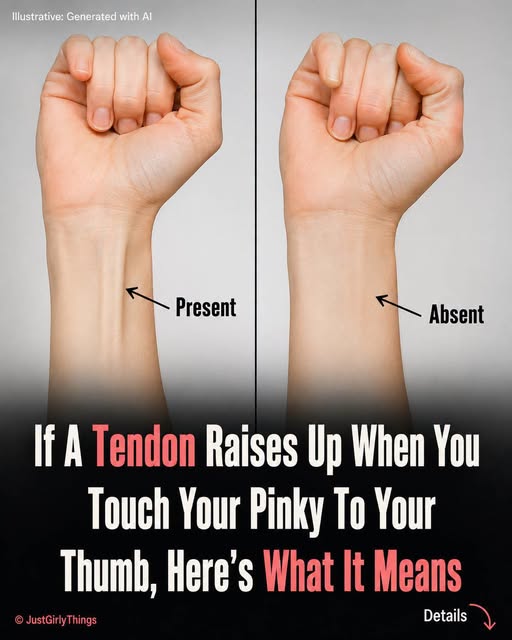
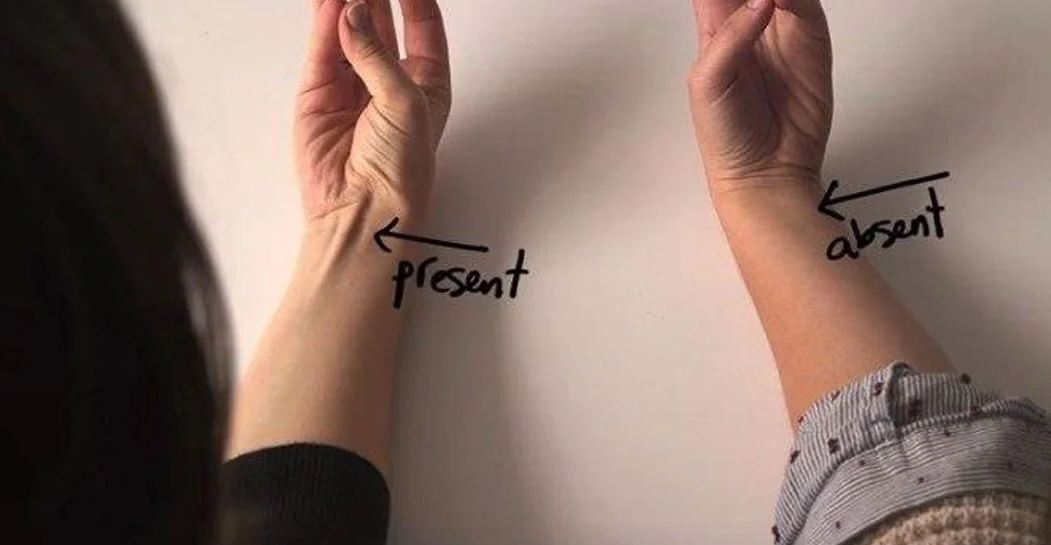
All it takes is touching your pinky finger to your thumb and slightly bending your wrist. For some people, a noticeable tendon immediately appears in the center of the wrist. For others, nothing shows up at all.
As it turns out, both results are completely normal.
The Tendon Behind the Test
The structure involved in this popular hand experiment is known as the palmaris longus tendon. This slender tendon runs from a muscle in the forearm down toward the palm of the hand. To check for it, place your hand palm-up, touch your pinky finger to your thumb, and gently flex your wrist. If the tendon is present, it often becomes visible as a raised line running through the middle of the wrist. While some people can easily spot it, others may struggle to see anything at all. That difference comes down to genetics rather than health.
Not Everyone Has One
One of the most surprising facts about the palmaris longus tendon is that not everyone is born with it. Studies have found that a significant percentage of people naturally lack the tendon in one or both arms. Depending on the population being studied, the absence rate can vary considerably, with estimates ranging from around 10 percent to more than 25 percent of individuals. Even more interesting, a person may have the tendon in one wrist but not the other. This variation is considered completely normal and is not associated with any medical condition or disability.
Does It Serve an Important Purpose?
For most people, the absence of the palmaris longus tendon has little or no effect on daily life. Researchers consider it a vestigial structure, meaning it is a leftover feature from earlier stages of human evolution. Similar muscles are more useful in animals that rely heavily on climbing, gripping, or moving through trees. As human movement patterns evolved over thousands of years, the tendon gradually became less important. Today, many people function perfectly well without it and may never realize it is missing. In fact, most individuals who lack the tendon discover it only after performing the wrist test or undergoing a medical examination.
Why Surgeons Find It Useful
Although the tendon is not essential for normal hand function, it still has value in modern medicine. Because removing it usually causes little to no noticeable loss of strength, surgeons sometimes use the palmaris longus tendon in reconstructive procedures. It can serve as a replacement tendon elsewhere in the body when repairing injuries or restoring damaged tissue. This makes it a convenient source of graft material, particularly because many patients experience no long-term problems after its removal. For surgeons, the tendon is often viewed as a useful spare part that nature has conveniently provided.
What Your Result Really Means
Many viral posts suggest that having or lacking the tendon reveals something special about a person’s health, strength, intelligence, or ancestry. However, there is no scientific evidence supporting such claims. The presence or absence of the tendon is simply a natural anatomical variation. Neither result is better than the other, and neither indicates superior physical abilities. If you can see the tendon, you are part of the group that inherited it. If you cannot, you belong to the millions of people worldwide who function perfectly without it.

A Fascinating Example of Human Diversity
The palmaris longus tendon serves as a reminder that human anatomy is not identical from person to person. Small variations exist throughout the body, from muscles and tendons to bones and blood vessels. Most of these differences go unnoticed because they rarely affect everyday life. Yet they provide fascinating insight into human evolution and the incredible diversity found within our species. So the next time someone asks you to touch your pinky to your thumb and look at your wrist, you’ll know exactly what you’re seeing. Whether a tendon appears or not, the result is simply one of many natural ways the human body can be uniquely designed.