
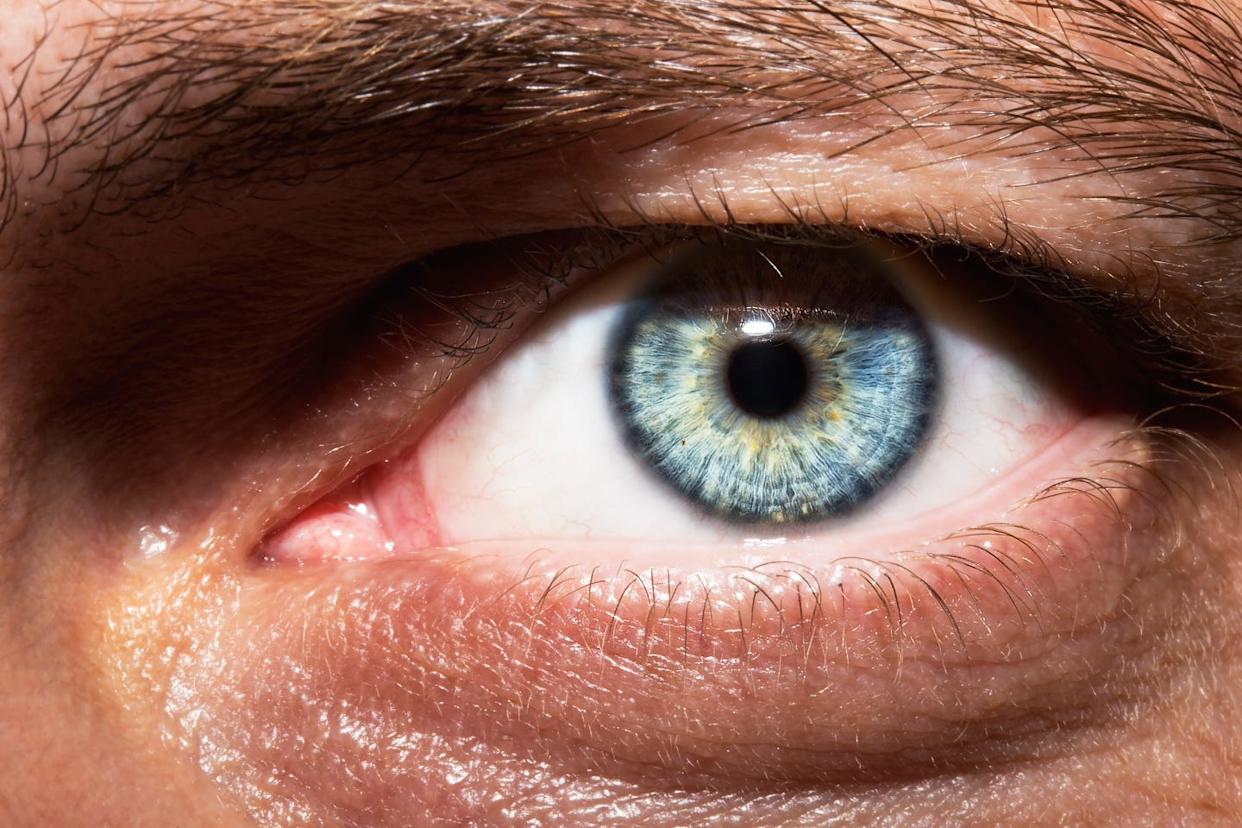
Blue eyes are often admired for their striking appearance, but scientists believe they also tell a remarkable story about human evolution. According to genetic research, nearly every person with blue eyes alive today may share a distant common ancestor who lived thousands of years ago.
This fascinating discovery has transformed the way researchers understand one of humanity’s most recognizable physical traits.
A World Once Dominated by Brown Eyes
Experts believe that early humans originally had brown eyes. Brown eye color results from higher levels of melanin, the pigment responsible for coloring the skin, hair, and irises. At some point in prehistoric history, however, a genetic mutation altered that pattern. Rather than creating an entirely new pigment, the mutation reduced the amount of melanin produced in the iris. As a result, eyes appeared blue because of the way light scattered through the iris tissue. This small genetic change eventually spread through generations and became one of the most recognizable eye colors in the world.

The Mutation That Started It All
Researchers discovered that most blue-eyed individuals share the same genetic variation near the OCA2 gene, which plays an important role in melanin production. The mutation functions like a switch, limiting how much pigment reaches the iris. Instead of producing brown eyes, the reduced pigment creates shades ranging from light blue to gray. Scientists found something particularly intriguing while studying this mutation: people from different regions who had blue eyes carried nearly identical genetic signatures around this specific area of DNA. That observation suggested the mutation most likely occurred only once.
One Common Ancestor
Based on genetic evidence, researchers proposed that the first person with this mutation lived between approximately 6,000 and 10,000 years ago, likely somewhere near the Black Sea region. As populations migrated and mixed throughout Europe and neighboring areas, the trait spread to future generations. The finding means that many blue-eyed people living today may trace this characteristic back to a single individual who unknowingly introduced a permanent change into the human gene pool. It is an extraordinary reminder of how interconnected humanity truly is.
Why Did Blue Eyes Persist?
Scientists continue debating why blue eyes became relatively common in certain populations. One possibility involves natural selection. In regions with lower sunlight exposure, lighter pigmentation may have offered certain advantages related to vitamin D production. Others suggest that blue eyes may have become attractive traits during mate selection, increasing the likelihood that individuals carrying the mutation passed it on to their children. The true explanation may involve a combination of environmental influences and social preferences over thousands of years.
Not Every Blue Eye Story Is Identical
Although the shared ancestor theory applies to most blue-eyed people, researchers have identified exceptions. Studies have revealed that a small number of individuals possess blue eyes due to different genetic variations. In these cases, the trait developed through alternative pathways rather than the original mutation. This means eye color inheritance is more complex than scientists once believed. Instead of being controlled by a single gene, eye color results from interactions among multiple genetic factors.
A Window Into Human Evolution
The story of blue eyes demonstrates how a tiny change in DNA can shape the appearance of millions of people across countless generations. What began as a single mutation thousands of years ago eventually became a defining characteristic shared by communities around the world. Whether viewed as a beautiful feature or a scientific curiosity, blue eyes offer an extraordinary glimpse into humanity’s shared past. They remind us that despite our differences, our histories are deeply connected—often in ways we are only beginning to understand.