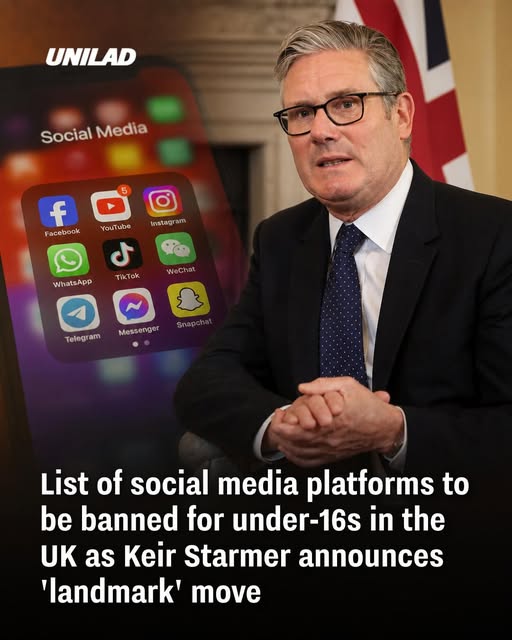
The UK government has announced plans to introduce one of the world’s strictest online safety measures by banning children under the age of 16 from accessing major social media platforms. Prime Minister Keir Starmer described the move as the “right choice,” arguing that social media is exposing young people to harmful content and negatively affecting their wellbeing. If approved by Parliament, the new rules are expected to come into force in early 2027, marking a major shift in how children interact with the digital world.
Which Platforms Will Be Banned?
Under the proposed legislation, children under 16 would no longer be allowed to hold accounts on several of the world’s most popular social media platforms.
The list includes:
Facebook
Instagram
Snapchat
X
TikTok
YouTube
These platforms collectively have millions of teenage users and have become central to modern communication, entertainment, and self-expression. The government argues that despite their benefits, they also expose young users to addictive features, harmful content, and unwanted contact from strangers.
Which Apps Are Exempt?
Not every digital service will be affected. Messaging applications such as WhatsApp and Signal are currently expected to remain available to younger users. Educational tools, music streaming services, and other non-social platforms are also likely to avoid the restrictions. Officials say the distinction is based on risk, with the focus placed on services that rely heavily on algorithm-driven feeds, public interaction, and engagement features designed to maximize screen time.
Additional Restrictions Are Being Considered
The proposed ban is only one part of a broader online safety initiative. The government is also exploring measures that would limit potentially harmful digital features for teenagers, including:
Overnight social media curfews,
Mandatory breaks from infinite scrolling,
Restrictions on livestreaming,
Limits on communication with strangers,
Stronger protections on gaming platforms.
In addition, AI-powered “romantic companion” chatbots that simulate intimate relationships may become restricted to adults aged 18 and over.
Why Is the Government Taking Action?
According to the Prime Minister, parents have increasingly voiced concerns about the impact social media is having on children’s happiness and mental health. Government consultation findings revealed overwhelming public support for stronger protections, with around nine out of ten parents backing some form of social media restriction for under-16s. Starmer acknowledged that digital platforms provide benefits, including opportunities for learning and connection, but argued that current safeguards have not gone far enough. He said many parents feel they are trying to protect their children while competing against powerful technology companies and increasingly addictive online environments.
Can the Ban Actually Work?
One of the biggest questions surrounding the proposal is enforcement. Officials are expected to rely on enhanced age-verification systems overseen by Ofcom. These could involve facial age estimation technology, digital identification methods, or other verification tools. However, critics warn that determined teenagers may still find ways around restrictions through methods such as VPNs or alternative platforms. Others argue that age bans alone cannot address broader concerns involving harmful algorithms and online culture.
A Defining Moment for Online Safety
If approved, the UK’s plan would place it among the global leaders pursuing tougher rules for children’s internet use, following similar action already introduced in Australia. Supporters view the policy as a necessary step to protect young people during a crucial stage of development. Critics remain concerned about privacy, enforcement, and unintended consequences. Regardless of where the debate ultimately lands, the proposal signals a major change in how governments are beginning to rethink the relationship between children, technology, and social media in the digital age.