
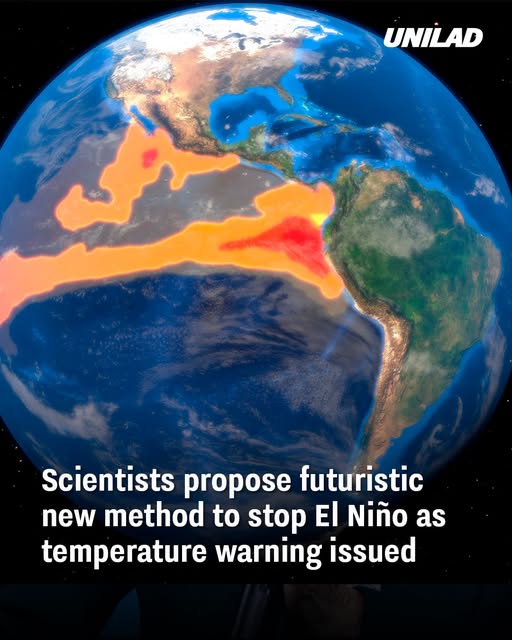
Scientists are investigating an innovative climate engineering technique that could one day reduce the intensity of powerful El Niño events, potentially limiting some of the devastating weather they bring around the world. While the proposal remains purely theoretical and has not been tested outside computer simulations, researchers believe it could become an important tool for understanding how to manage future climate risks.
El Niño is a naturally occurring climate pattern that develops when sea surface temperatures in the central and eastern Pacific Ocean become warmer than usual. These warmer waters influence atmospheric circulation, often leading to severe droughts in some regions while causing flooding, heatwaves, and powerful storms in others. As scientists warn that the current El Niño could become exceptionally strong, interest in possible ways to reduce its impacts has grown.
A New Approach to Cooling the Ocean
The proposed method focuses on a technique known as marine cloud brightening. Researchers suggest spraying tiny sea salt particles into low-lying marine clouds over parts of the Pacific Ocean. These additional particles would make the clouds brighter, allowing them to reflect more sunlight back into space. With less solar energy reaching the ocean surface, water temperatures beneath the clouds could cool slightly. Scientists believe this cooling may interrupt the chain of events that allows an El Niño to strengthen during its early stages. Computer models indicate that beginning this process soon after El Niño starts could significantly weaken the event before it reaches peak intensity.

Why El Niño Matters
Although El Niño is a natural climate cycle, its effects can be felt across much of the globe. Some countries experience prolonged droughts that threaten agriculture and water supplies, while others face intense rainfall, flooding, and landslides. Fisheries may also suffer as changing ocean temperatures disrupt marine ecosystems. In recent decades, strong El Niño events have been linked to billions of dollars in economic losses and widespread humanitarian challenges. Scientists also note that a warming climate may amplify the impacts associated with particularly strong El Niño events, making improved forecasting and preparedness increasingly important.
Simulations Show Encouraging Results
Rather than conducting real-world experiments, the research team used advanced climate models to recreate previous major El Niño events. The simulations suggested that strategically brightening clouds over a specific part of the Pacific Ocean consistently reduced the strength of the modeled El Niño episodes. By cooling the ocean early enough, the process appeared to weaken the feedback loop that normally causes sea temperatures to continue rising. Researchers emphasize that these findings are based entirely on computer simulations. Much more work would be needed before anyone could determine whether such an approach would function safely under real-world conditions.
Questions and Concerns
Despite the promising results, many scientists urge caution. Geoengineering techniques such as marine cloud brightening could potentially influence rainfall patterns, ocean circulation, or regional weather in ways that are difficult to predict. Even if one area benefits from cooler temperatures, another region could experience unintended consequences. There are also ethical and political questions surrounding who would decide if, when, and where such technologies should ever be deployed. Because Earth’s climate is interconnected, actions taken in one region could affect communities thousands of miles away. For these reasons, experts stress that any future research would require careful international oversight and extensive environmental assessment before any large-scale testing could even be considered.
Looking Toward the Future
The study does not suggest that scientists are ready to “switch off” El Niño. Instead, it offers a glimpse into how emerging technologies might one day help reduce the severity of some climate extremes. Most climate researchers agree that reducing greenhouse gas emissions remains the most effective long-term strategy for limiting the impacts of climate change. At the same time, studies like this help scientists better understand the complex interactions between oceans, clouds, and the atmosphere. Whether marine cloud brightening ever becomes a practical solution remains uncertain. However, the research demonstrates how advances in climate science continue to explore innovative ways to better prepare for an increasingly unpredictable future while highlighting both the potential benefits and the significant risks of intervening in Earth’s natural climate systems