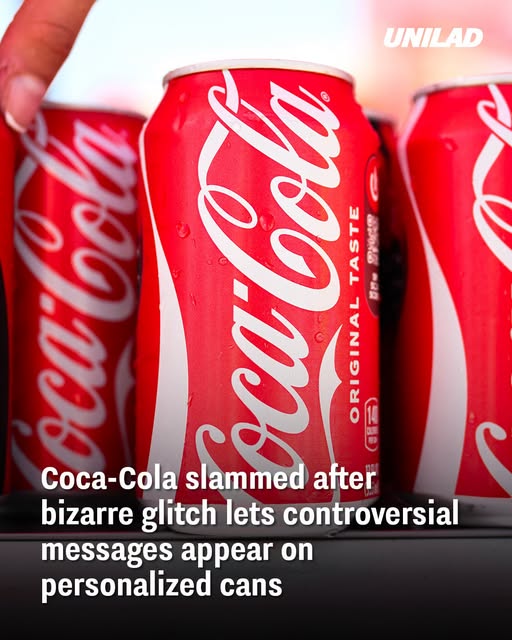
Coca-Cola is facing criticism after customers discovered an unusual problem with the company’s personalized can feature. The “Share a Coke” customization tool allows customers to create personalized cans by adding a name or short phrase. However, users recently discovered that the system appeared to be making inconsistent decisions about which messages were acceptable. Some ordinary religious and political phrases were reportedly rejected, while other controversial expressions were allowed to pass through the same moderation system.
The discovery has sparked questions about how Coca-Cola’s automated filtering system works and why certain expressions appear to be treated differently from others.
Religious Messages Were Blocked
The personalization feature is designed to prevent users from submitting phrases that are religious, political, trademarked or otherwise considered inappropriate. However, testing of the system reportedly revealed some surprising results. Phrases such as “Jesus is Lord” and “Allah is Lord” were reportedly rejected. At the same time, other religious or non-religious expressions, including “God is Dead,” “Atheist Pride,” “Shalom” and “Buddha Bless,” were apparently accepted. The apparent inconsistency quickly attracted attention because the system’s stated rules suggested that religious expressions should generally be restricted. For customers, the issue raised questions about whether the filter was properly identifying different categories of language or whether an underlying technical problem was responsible.
Political Phrases Also Caused Confusion
The same problem appeared to affect political messages. According to testing reported on the personalization tool, phrases including “Make America Great,” “White Pride,” “Black Pride” and “Black Lives Matter” were blocked. Names of political figures were also reportedly rejected. However, other politically charged expressions were apparently permitted. Among the phrases reported as passing through the system were “Defund the Police” and “Proud Boys.” The results created an unusual situation in which seemingly similar political statements could receive completely different responses from the same automated filter. Another example involved geopolitical slogans. “Stand with Israel” was reportedly permitted, while “Free Palestine” was blocked.
More Serious Messages Slipped Through
The most concerning discovery involved phrases associated with sexual attraction to minors. Some extremely inappropriate expressions reportedly passed through the filter, despite Coca-Cola’s system being designed to prevent unsuitable content from appearing on customized products. The investigation also found that users could sometimes manipulate blocked phrases by changing the way letters were written or replacing characters with numbers. That raised additional concerns because an effective moderation system should ideally be capable of recognizing obvious attempts to bypass restrictions. The fact that such phrases could potentially reach the personalization stage intensified criticism of the system.
Coca-Cola Responds
Coca-Cola has acknowledged that there was a problem with its personalization preview tool. A company spokesperson explained that the feature was created to allow fans to celebrate and connect with one another. The company said it became aware of a technical issue affecting the preview system and was working to resolve it. Coca-Cola subsequently disabled the preview feature and paused new personalized orders while the issue was investigated. The company also emphasized that safeguards are supposed to prevent religious, political, trademarked, inappropriate or otherwise restricted phrases from being approved and printed on cans and bottles.
What Happens Next?
The incident highlights the difficulties companies can face when automated systems are responsible for deciding what content is acceptable. Coca-Cola’s personalization feature is intended to be a fun way for customers to create products featuring their own names or messages. However, the reported inconsistencies demonstrate how quickly a technical problem can become a major public-relations issue. For now, customers will have to wait while Coca-Cola investigates the problem and works on its moderation system. The company has not indicated exactly when the personalized preview feature or new orders will return, but the incident is likely to increase scrutiny of how automated content filters make decisions about sensitive language.