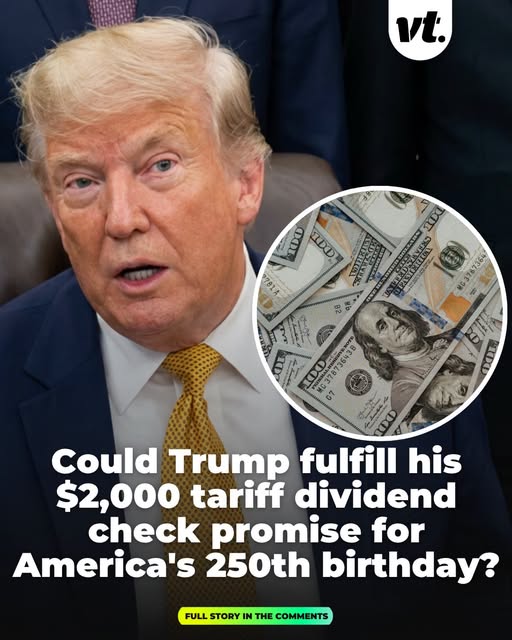
President Donald Trump has suggested that Americans could receive a one-time payment of up to $2,000 funded by revenue collected from tariffs on imported goods. The proposal, which Trump referred to as a “tariff dividend,” was discussed as part of a broader conversation about celebrating the United States’ 250th anniversary in 2026. The idea immediately sparked widespread debate, with supporters praising the potential financial boost for households while critics questioned whether tariff revenue could realistically fund such payments.
Although the proposal has attracted significant attention, no legislation has been introduced, and the payments have not been approved by Congress. For now, the idea remains a proposal rather than an official government program.
What Is A Tariff Dividend?
Speaking about the concept, Trump argued that increased revenue generated through tariffs could eventually be returned directly to American citizens. Under the proposal, eligible Americans could receive a one-time payment of approximately $2,000 as part of celebrations marking the nation’s semiquincentennial, or 250th birthday. Trump suggested that tariff collections have exceeded expectations and could provide enough revenue to reward taxpayers while also supporting federal priorities. However, he did not provide detailed information about who would qualify for the payments, how eligibility would be determined, or exactly when the money would be distributed if the proposal were approved. Those details would ultimately depend on congressional action and future federal budget decisions.
Supporters Say Tariffs Are Producing Results
Supporters of the proposal argue that tariffs encourage domestic manufacturing while generating additional revenue for the federal government. Some economists who favor tariffs believe that if import taxes produce larger-than-expected income, returning part of those funds directly to citizens could help offset rising living costs and increase consumer spending. Advocates also say a payment tied to America’s 250th anniversary could serve as a symbolic way to share the economic benefits of trade policies with the public. Supporters describe the proposal as similar in concept to previous government stimulus payments, although funded through a different revenue source.
Critics Question The Economics
Not everyone agrees that tariff revenue should be distributed through direct payments. Many economists argue that tariffs are generally paid by importers, with at least part of those costs often passed on to businesses and consumers through higher prices. Critics therefore contend that using tariff revenue for dividend checks could simply return money that consumers effectively helped generate through increased costs. Others question whether tariff collections would remain high enough to finance billions of dollars in direct payments without affecting other areas of the federal budget. Some analysts also note that government revenue fluctuates from year to year, making long-term planning based on tariff income difficult.
Would Americans Actually Receive The Money?
At this stage, there is no guarantee that Americans will receive a tariff dividend. Before any payments could be issued, Congress would need to approve legislation authorizing the program and determining how it would be funded. Lawmakers would also need to establish eligibility requirements, payment amounts, and a distribution process similar to previous federal relief payments. Without congressional approval, the proposal cannot move forward regardless of presidential support. For now, there is no official application process, payment schedule, or confirmed list of recipients.
A Proposal Generating National Debate
The suggestion has quickly become one of the most talked-about economic proposals of the year, generating intense discussion across political and financial circles. Supporters see it as an opportunity to share government revenue directly with the public during a historic national celebration, while opponents question both its economic logic and financial feasibility. Whether the idea eventually becomes reality remains uncertain, but it has already sparked renewed debate over tariffs, government spending, and how additional federal revenue should be used. Until lawmakers take formal action, Americans should view the proposed $2,000 tariff dividend as a policy idea rather than a guaranteed payment.