
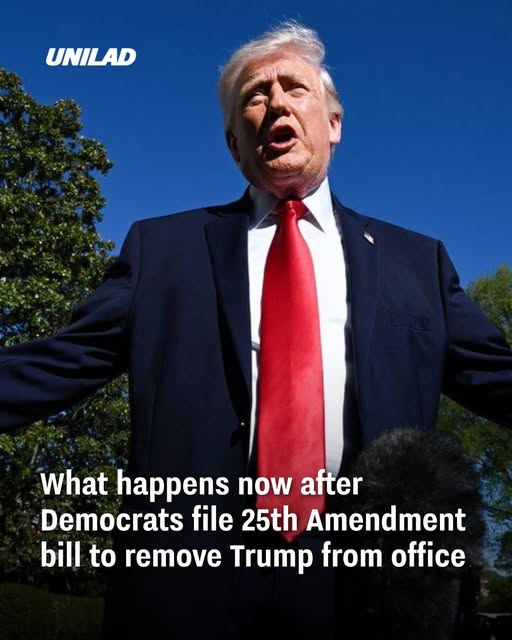
The 25th Amendment to the U.S. Constitution sets out what happens if a president can’t carry out their duties. It was adopted in 1967 to clarify confusion about presidential succession and incapacity. It doesn’t automatically remove a president for political reasons. Instead, it focuses on situations where a president is considered unable to perform their role, whether temporarily or permanently.
How the Process Works
The part most often discussed in political debates is Section 4 of the amendment. This is the only part that allows action without the president’s consent.
Here’s how it works step by step:
- The Vice President and a majority of the Cabinet must agree that the president is unable to perform their duties.
- They send a written declaration to Congress stating this.
- The Vice President immediately becomes Acting President.
At this point, the president is still officially in office—but no longer has power.

What Happens If the President Disagrees
The process doesn’t end there. The president can challenge the decision:
- If the president says they are fit to serve again, they can send their own declaration.
- Then, the Vice President and Cabinet have 4 days to respond if they still disagree.
- If they continue to insist the president is unfit, Congress gets involved.
- Congress Makes the Final Call
When there is a dispute, Congress must decide:
- Both the House and Senate must vote.
- A two-thirds majority in both chambers is required to keep the Vice President as Acting President.
If that threshold is not reached, the president regains their powers.
Why It’s Rarely Used
Although the amendment provides a clear process, it is extremely difficult to carry out in practice:
- It requires cooperation from the Vice President and Cabinet.
- It needs overwhelming support in Congress.
- It can quickly become a political battle rather than a purely constitutional decision.
In fact, Section 4 has never been successfully used to remove a president against their will.
Why It’s Being Discussed Now
Recent political tensions have brought renewed attention to the amendment. Some Democratic lawmakers have proposed creating a commission to evaluate whether a president is fit for office, though such efforts face major political obstacles. At the same time, critics and former officials have argued that the amendment exists specifically for situations involving concerns about a president’s judgment or behavior. However, experts note that actually invoking it would still be highly unlikely given the level of agreement required across government.

Conclusion
The 25th Amendment is essentially a constitutional safety mechanism, not a quick way to remove a president. While it allows for the transfer of power in cases of incapacity, the process is complex, politically sensitive, and requires broad agreement at the highest levels of government. That’s why, despite frequent public discussion, it remains more of a theoretical tool than one commonly used in real political situations. This is why discussions around the amendment often remain theoretical. While it continues to be referenced in media and political conversations, especially in connection with high-profile leaders, the practical barriers make its use highly unlikely in most scenarios. Ultimately, the amendment serves as a safeguard built into the system—one that ensures continuity of leadership in extreme cases, while also protecting the stability of the presidency from impulsive or partisan actions.