
When Matthew introduced his girlfriend Wendy to his mother, Margaret, something felt off from the start. Margaret had recently been caring for her grandson Alex a six-year-old boy coping with the death of his mother. The hope was that Wendy might become a supportive partner for Matthew, and perhaps a caring stepmother to Alex. Instead, Wendy’s behavior hinted at a different kind of plan: one that excluded the child entirely.
The First Impressions: Style Over Substance
At the first brunch meeting, Wendy was beautiful and polished. She spoke confidently about her career as an interior designer, her recent travels, and her refined tastes — but never once asked about Alex. When Matthew described his son’s recent soccer match, Wendy reacted with nothing more than a perfunctory smile. She seemed more interested in appearance than empathy. Margaret watched as conversations flowed easily between Wendy and Matthew, while Alex sat quietly, clutching his sadness and confusion. Wendy had already begun reshaping Matthew’s life: redecorating his apartment, integrating him into a world of galleries, wine tastings, and high-end social events. Meanwhile, any sign of love, care, or curiosity for the child was conspicuously absent. Alex’s drawings, toys, and memories felt like clutter to her.
Engagement — And a Wound That Would Be Hidden
Months passed. Matthew proposed, and Wendy accepted. The engagement party confirmed what Margaret had feared: the night felt tailored to adults only, with no accommodations for a child. The loft where it was held looked like a curated showroom, not a home meant to shelter a young boy’s laughter and energy. There were no children’s snacks, no distractions for a restless six-year-old, and certainly no hint that Alex would one day be part of the family. Wendy dismissed the idea of Alex walking down the aisle or playing a role in the wedding. She said the ceremony needed to be “adults-only,” and that Alex might find the proceedings too long or uncomfortable — a manufactured excuse to keep him out of what she considered her perfect day.
A Silent Rebellion: Capturing the Truth
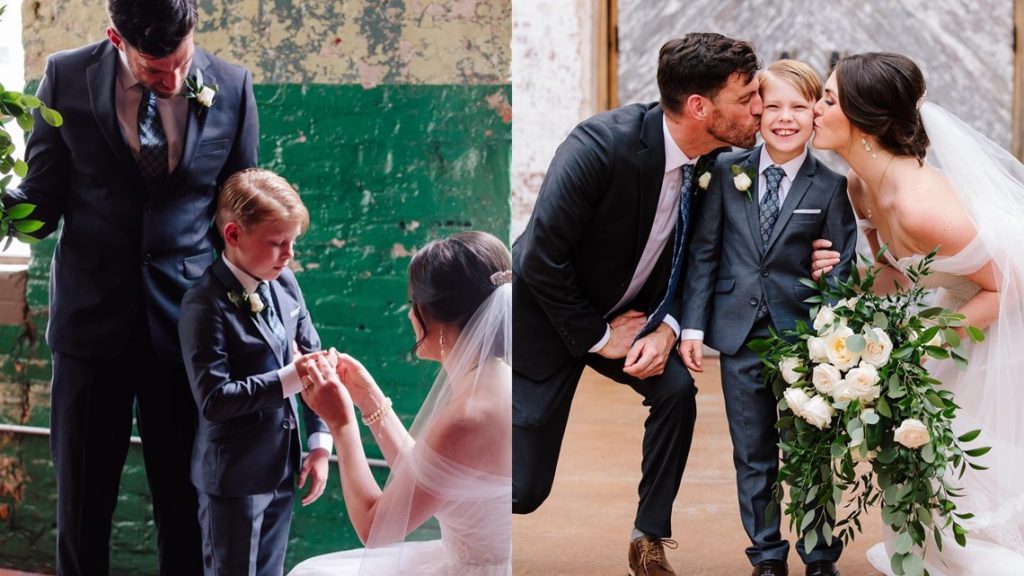
Margaret, the grandmother, quietly decided she would not let Alex be erased. Without fanfare, she hired a second photographer — one who specialized not in staged portraits, but in capturing real emotions and unguarded moments. She planned for Alex to attend the wedding, dressed in a little suit, carrying a bouquet of white roses, and supported by her. On the wedding day, the setting was exquisite: an elegant estate, tastefully decorated with imported flowers, soft lighting, and gourmet catering. On paper, it was perfect. In reality, it was a stage built to exclude a child. When Wendy noticed Alex and Margaret entering, she froze. She asked why Alex was there, reminding them (to no one in particular) that they had agreed he should stay home. The answer was gentle but firm: Alex was coming. He was not a guest. He was part of the family.
Exclusion in Full View
During the ceremony and the reception, the exclusion was stark. Alex was never mentioned. No role, no acknowledgment, no attempt to make him part of the day. When family portraits were taken, Wendy stepped between Alex and the camera, refusing to let him appear in any formal photograph. The groom, Matthew, looked helpless as his son stood alone — visibly hurt and belittled — while others partied around him. The photographer Margaret had secretly hired captured the most telling moments: Alex watching his father with longing; Wendy pulling away from him; the father’s conflicted expression. These images spoke louder than any vows.
A Toast, A Gift, And An Awakening
Later that evening, Margaret raised her glass. Her toast was sincere, powerful, a reminder of what family truly means:
“May they learn that family isn’t a curated image — it’s a living, breathing thing. Especially when it includes a child who has already lost so much, and still hopes to be fully seen.”
Then, a child’s innocence broke through the tension. Alex walked toward his father with his bouquet, called Wendy “Mommy,” and offered the roses. His simple gesture hung in the air like a question: “Will you see me?”

For a moment, time seemed to pause. The carefully arranged illusions cracked.
Three weeks later, Margaret handed Matthew a gift: a leather-bound album filled with candid photos — captured by the secret photographer. The pictures revealed the truth: a child pushed aside, a woman who never intended to step into motherhood, and a father too eager to rewrite his past. As Matthew flipped through the album, realization dawned. The distance, the exclusion, the heartbreaking coldness toward his son could no longer be ignored.
Choosing Reality Over Perfection
Faced with the undeniable evidence, Matthew made his decision — not for himself, but for the child who mattered most. The wedding ended, and so did the relationship. Wendy walked away with her curated lifestyle. Matthew and Alex moved into a modest home filled with warmth, laughter, and love — where childhood could be messy, genuine, and safe. The day they came home together was quiet, but it spoke louder than any vows ever could. Alex got to be a child again. Matthew got to be a father. And their home became a real family portrait — imperfect, but honest.