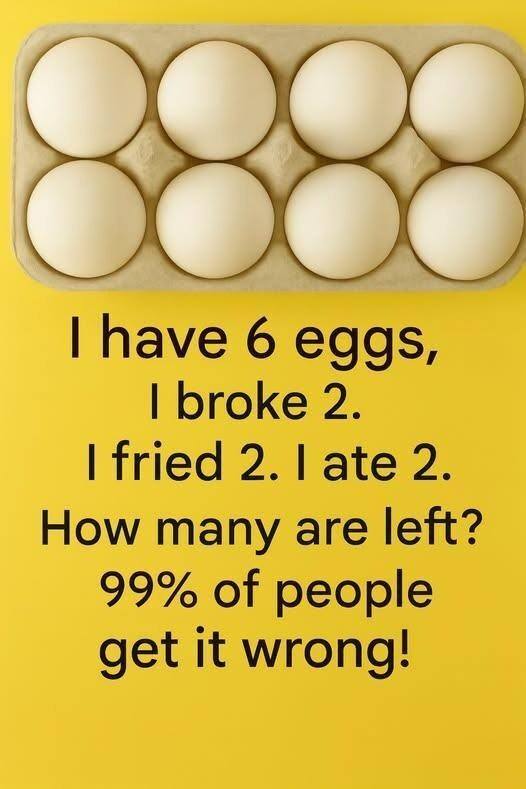
A short riddle that has been circulating widely on social media platforms recently has left many people scratching their heads. The puzzle is deceptively simple, but its phrasing challenges assumptions and tests logic rather than basic arithmetic:
“I have six eggs. I broke two, I fried two, and I ate two. How many eggs are left?”
At first glance, it might look like a straightforward subtraction problem. But as millions of users have discovered, the real puzzle lies in interpreting the language of the riddle correctly.
Why the Riddle Stumps People
The reason many people get the question “wrong” is that the verbs used — broke, fried, ate — seem to suggest sequential actions on different eggs. If someone assumes that each action applies to different eggs from the original six, the logical assumption would be that all six eggs are used up. This leads some solvers to answer zero eggs left. However, that interpretation is a trap. The riddle doesn’t explicitly state that the two eggs broken are separate from the two eggs fried, or that the fried eggs are not the ones eaten. Understanding whether these actions refer to the same eggs or different ones is key to solving the puzzle correctly.

The Most Common Logical Answer: Four Eggs Left
Most explanations of the riddle point to an interpretation that uses overlapping actions. In this view:
- The person starts with six eggs.
- They break two of them.
- Those same two eggs are then fried.
- After frying, the same two eggs are eaten.
- That means only two eggs have actually been consumed, and the remaining four eggs were untouched. So the answer — if understood this way — is that four eggs are left.
This interpretation has become the most widely accepted because it follows the simplest reading of the text without adding assumptions about additional eggs being used in each step.
An Alternative Interpretation: Six Eggs Still Present
Interestingly, some people offer a very different answer based on a grammatical and tense-based reading of the riddle. In this view, the phrase “I have six eggs” is in the present tense, while the actions (“broke”, “fried”, “ate”) are in the past tense. Because the first line is about the present and the others refer to past events, some argue that the riddle doesn’t actually say that the six eggs being referred to are the same eggs being broken or eaten. Under that interpretation, the answer could be that you still have six eggs now because the past actions don’t change the present count. This grammar-based explanation rarely becomes the “official” answer in viral posts, but it does illustrate how a seemingly simple riddle can generate multiple interpretations depending on how the language is read.
Why the Debate Matters
This riddle became so popular because it doesn’t have a single obvious answer. It plays on how people naturally think about sequences of actions and assumptions about whether items are reused or replaced. Puzzles like this often go viral because they reveal how easily our brains can jump to conclusions without thinking critically about each part of a statement. According to brain teaser enthusiasts, riddles that challenge assumptions help improve reasoning skills and highlight how language can be ambiguous.
Popularity Across Social Platforms
The riddle has shown up on platforms like Twitter, TikTok, Reddit, and WhatsApp, with users sharing their own answers and reasoning. Some answers argue for four eggs left, others for six, and a few argue for alternative philosophical answers, turning the relatively simple question into a broader conversation about logic and language.
Final Takeaways
At its core, the “I Have Six Eggs” riddle isn’t just about counting eggs — it’s about challenging assumptions and reading carefully. Whether you conclude that four eggs remain after the described actions, or that the structure of the sentence leaves you with six eggs, the exercise encourages critical thinking and highlights how small puzzles can prompt big discussions.