A clever puzzle has been circulating on social media that reads like a paradox:
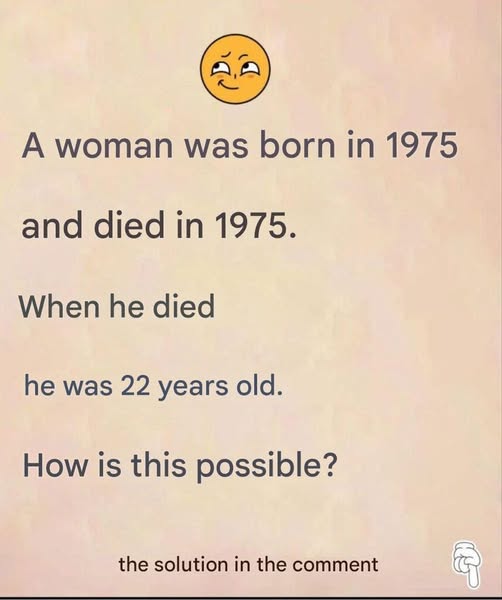
“A woman was born in 1975 and died in 1975. She was 22 years old at the time of her death. How is this possible?”
At first glance, it seems impossible how can someone both be born and die in the same year yet live to age 22? That contradiction traps many people in overthinking. But the riddle doesn’t actually violate logic once you break free from automatic assumptions about numbers.
Why This Riddle Works
The trick lies in how our brains automatically interpret numbers. When most people see “1975,” they instantly think of a year. That’s because 1975 is most commonly used as a calendar year in everyday conversation. But riddles like this one rely on that very assumption to create confusion and misdirection. Instead of anchoring the entire puzzle in a timeline, this riddle uses the same number twice — once for birth and once for death — without ever saying that “1975” is a year. Once you drop that assumption, the solution becomes clear and elegantly simple.
The Clever Solution
The answer is that “1975” refers to a room number — not a year. In this interpretation:
- The woman was born in room number 1975 at a hospital.
- She died in room number 1975 at the same hospital.
- She lived a full 22 years in real time — just not during the single year 1975.
- So the riddle plays on our instinct to interpret “1975” as a year. When you realize it could instead be a location number, everything makes sense.
How People Usually Get Tricked
When you read the riddle quickly, you naturally insert the assumption that “1975” must mean the year 1975 because:
- Four‑digit numbers are most often used to represent calendar years in everyday language.
- The riddle mentions birth and death, which are normally associated with dates on a timeline.
- Our brains use mental shortcuts (called heuristics) when interpreting numbers, and the year interpretation is the easiest and most familiar.
- Because of these subconscious patterns, most solvers get stuck inside the assumption instead of questioning it. Once you step back and consider alternative meanings for “1975,” the riddle resolves cleanly.
What This Puzzle Teaches Us
This riddle highlights a broader point about how our cognition processes information:
🧠 1. Challenge Assumptions
Often, the first thing we assume isn’t necessarily the right interpretation. Riddles like this one challenge us to think beyond default assumptions about context.
🔍 2. Look for Multiple Meanings
Numbers, words, and statements can have more than one valid interpretation. Thinking laterally instead of linearly helps unlock solutions that look impossible at first.
💡 3. Perspective Matters
Understanding context — or questioning default context — is the key to solving many riddles. In this case, seeing “1975” as something other than a year completely changes the meaning of the puzzle.
Why People Love This Riddle
Smart riddles have a long history of captivating people because they:
- surprise us with clever twists,
- make us feel accomplished when we “get it,” and
- force us to think more creatively and flexibly.
- Riddles like this one aren’t just fun — they’re a mental exercise that strengthens reasoning skills and helps us recognize when we might be jumping to intuitive but incorrect conclusions.

In short, the key to the “1975” riddle is not in dates on a calendar but in the meaning we assume those numbers have. Once you reinterpret “1975” as a location like a room number, everything fits logically — and the puzzle’s seeming contradiction disappears.