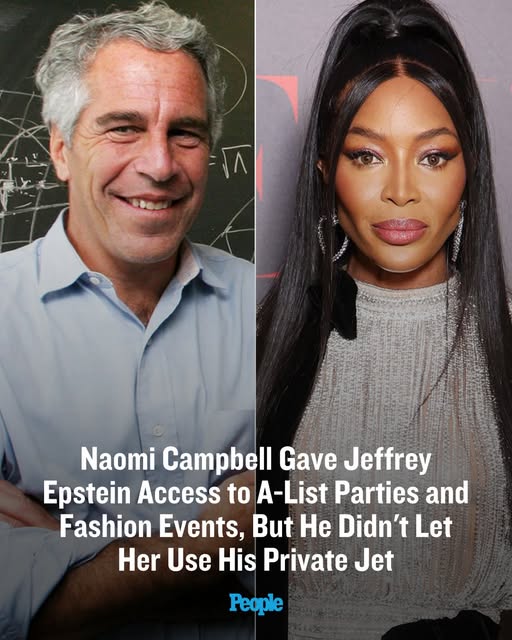
Recently unsealed files from the U.S. Department of Justice have provided fresh insight into the relationship between Naomi Campbell and Jeffrey Epstein, the convicted sex offender whose network of powerful contacts has been under intense scrutiny for years. The documents include call sheets, emails, and schedules showing that Campbell and Epstein maintained a line of communication spanning more than a decade. These interactions reportedly began in the early 2000s and continued in various forms through at least 2016, even after Epstein’s 2008 conviction for soliciting a minor.
The correspondence suggests that Campbell occasionally invited Epstein to high-profile fashion events and personal celebrations, effectively introducing him to some of the elite social circles she moved in as one of the world’s most recognisable supermodels.
Invitations to Elite Events
Among the social occasions documented in the files was Campbell’s 2004 birthday party in St. Tropez, which Epstein attended after being invited by the model. Other notable gatherings included a celebration in Paris marking Campbell’s long association with a major luxury fashion brand, and a charity event in Moscow, which was held while Epstein was under house arrest. Emails also show that Epstein’s assistants reached out to Campbell to coordinate logistics and personal meetups while he was travelling abroad, indicating a degree of familiarity between the two parties. Although this pattern of invitations placed Epstein in contact with high-status circles, there is no evidence in the documents that Campbell was aware of, or involved in, Epstein’s criminal activities at the time.

The Jet Request and End of Contact
In January 2016, the correspondence appears to capture a moment that may have signalled the end of their interaction: a request from Campbell to use Epstein’s private jet for travel to Miami. The documents show that she attempted to get in touch regarding the arrangement, but Epstein ultimately did not agree to provide the plane for that purpose. This episode, which involved multiple emails between Epstein and his assistants, seems to have been the final exchange recorded in the files and may have contributed to the dissolution of the relationship between them.
Broader Mentions and Controversy
Campbell’s name appears multiple times in the newly released files, and some elements of the wider public — including survivors and commentators — have interpreted the mentions as reflecting her proximity to Epstein’s world during the years he was building influence across fashion, entertainment, and international society. One victim has even shared photos from events where Epstein and Campbell were both present, using the imagery to highlight how many powerful people were in Epstein’s orbit. Some media reports have also suggested that Epstein used his association with Campbell to bolster his appeal to young women, allegedly implying that she could help advance their careers if they engaged with him, though these reports note that there is no direct evidence that Campbell herself recruited anyone or was involved in criminal conduct.
Campbell’s Public Response
Campbell has addressed the renewed scrutiny directly, reiterating statements she initially made in 2019 when earlier batches of Epstein-related documents surfaced. On social media, she emphasised that being mentioned in the files does not mean she committed any wrongdoing and that she had no knowledge of Epstein’s criminal actions while they knew each other. She made it clear that if she had been aware of abusive conduct, she would have taken steps to intervene or help potential victims. Her legal team has also stressed that her interactions with Epstein took place in the context of social and professional circles, not criminal conspiracy, and that there is no indication she was complicit in or supportive of his offences.

Context Within the Broader Epstein Files
Campbell is among many high-profile individuals whose names appear in the multi-million page archive of documents related to Epstein’s activities and network. While the volume of references has reignited debate about the breadth of Epstein’s connections, legal experts have reiterated that association or acquaintance alone does not equate to criminal complicity. Moreover, many people mentioned in the files have publicly condemned Epstein’s crimes and expressed solidarity with his survivors. Public reaction remains mixed, with some defending Campbell’s position and others questioning why powerful individuals maintained social access to Epstein even after his initial conviction. The newly released materials are likely to continue fueling discussion around how figures in elite spheres intersected with Epstein’s world, and what responsibilities those individuals may have had in recognising and responding to warning signs.