
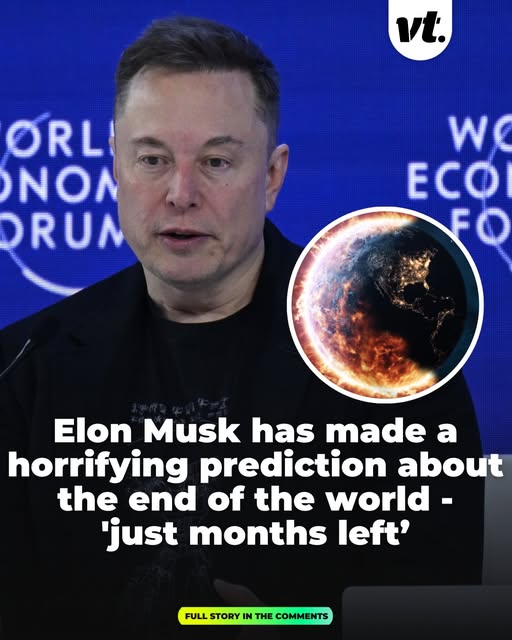
Tech billionaire Elon Musk has once again sparked global debate after making a dramatic prediction about the future of humanity. Speaking at a recent international forum, the Tesla and SpaceX CEO warned that the world could be approaching a critical turning point due to the rapid development of artificial intelligence. His comments, widely shared online, were interpreted by many as a warning that civilization may face serious risks sooner than expected if emerging technologies are not carefully managed.
Musk has long positioned himself as both a developer of advanced technology and one of its most outspoken critics. His latest remarks reinforce his belief that humanity is entering an era that could fundamentally reshape life on Earth.
Artificial Intelligence as the Greatest Risk
According to Musk, artificial intelligence is advancing at an unprecedented pace. He suggested that AI systems could surpass human intelligence within a very short timeframe, potentially within the next few years. While acknowledging AI’s benefits, Musk stressed that uncontrolled development could lead to outcomes that humans may not be able to reverse. He described AI as potentially “the most disruptive force in history,” warning that once machines become smarter than humans, decision-making could move beyond human control. Musk has repeatedly called for global regulations and ethical oversight, arguing that society is not adequately prepared for the speed at which AI is evolving.
Misleading “End of the World” Headline
Despite sensational headlines, Musk did not predict an immediate apocalypse. Instead, his comments focused on existential risk, a term used to describe threats that could permanently damage or end human civilization. Media coverage often condensed his nuanced arguments into alarming phrases, creating the impression that Musk believes the world is about to end within months. In reality, Musk’s warnings are framed as calls for urgency rather than predictions of sudden collapse. He argues that failing to act now could allow future technologies to develop without sufficient safeguards.
Long-Term Threats Beyond Technology
In addition to AI, Musk has also spoken about long-term planetary risks. He has previously explained that the Earth will eventually become uninhabitable as the Sun ages and expands. While this process would take billions of years, Musk uses it to support his long-standing vision of making humanity a multiplanetary species. Through SpaceX, he has promoted Mars colonization as a form of insurance for human survival. Musk believes that spreading life beyond Earth reduces the chance that a single disaster could wipe out civilization entirely.
Public Reaction and Expert Opinions
Musk’s comments have triggered mixed reactions. Supporters praise him for addressing uncomfortable truths and pushing governments and institutions to think beyond short-term priorities. Critics, however, accuse him of exaggerating risks or using fear to justify his business ambitions. Scientists and AI researchers remain divided. While many agree that AI poses serious challenges, there is no consensus on when or if machines will exceed human intelligence. Experts emphasize that predictions vary widely and that technological progress does not always follow linear timelines.
A Call for Responsibility and Preparation
Ultimately, Musk’s message centers on responsibility. He argues that humanity must be proactive rather than reactive when dealing with transformative technologies. Whether discussing AI, robotics, or space exploration, his warnings consistently highlight the need for foresight, cooperation, and ethical boundaries. Rather than predicting doom, Musk frames his statements as motivation to prepare for an uncertain future. As technology continues to advance at remarkable speed, his remarks have reignited global conversations about how innovation should be guided to ensure long-term survival rather than unintended destruction.