
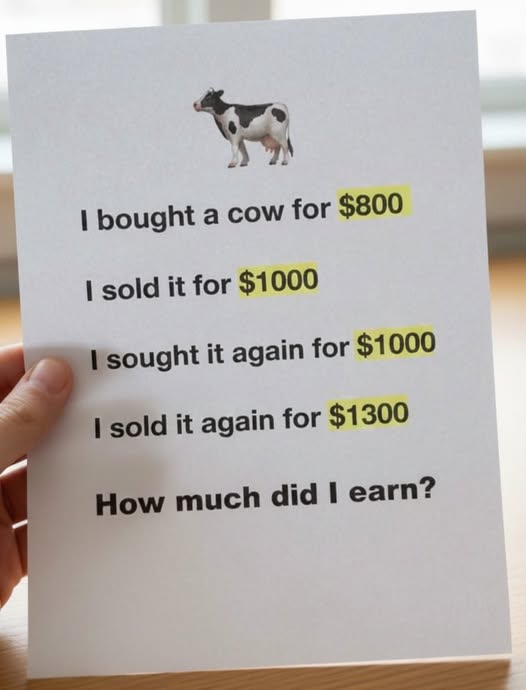
At first glance, the viral “cow math” puzzle looks almost too simple to be interesting. It uses small numbers, basic buying and selling, and a farm animal as the main character. Yet despite its simplicity, thousands of people online argue over the answer. Some say the profit is $200, others say $300, and a few even come up with much bigger numbers. The truth is that the puzzle is designed to test how carefully you follow money through a series of transactions.
Let’s look at it step by step and see why the correct answer surprises so many people.
The Story Behind the Puzzle
The puzzle goes like this:
You buy a cow for $800. Then you sell that same cow for $1,000. After that, you buy the cow back for $1,100. Finally, you sell it again for $1,300. The question is simple: how much money did you make in total? Even though it sounds straightforward, the back-and-forth buying and selling causes confusion. People tend to focus on only one part of the story instead of looking at the whole picture.
Breaking Down the First Transaction
In the first step, you spend $800 to buy the cow. That is your initial investment. When you sell the cow for $1,000, you get back more than you paid. The difference between what you sold it for and what you bought it for is $200. That means you made a $200 profit on the first sale. At this point, things are very clear. You spent $800, earned $1,000, and walked away $200 ahead.
What Happens When You Buy the Cow Again
Next, you decide to buy the cow back, this time for $1,100. Even though you already made $200 from the first sale, this second purchase still costs the full $1,100. Many people make the mistake of thinking the previous profit somehow reduces this price, but in reality, you still paid $1,100 to get the cow again. Now you own the cow once more, but you are $1,100 out of pocket for this second purchase.
The Final Sale
You then sell the cow for $1,300. Once again, you made more money than you spent. If you compare the buying price of $1,100 with the selling price of $1,300, you earned another $200 in profit. So, just like the first time, the second round of buying and selling also gave you a $200 gain.
Adding It All Together
Now comes the most important step: adding both profits together. From the first sale, you made $200. From the second sale, you made another $200. When you combine them, your total profit is $400. Another way to look at it is to count all the money that went out and all the money that came in. You spent $800 on the first purchase and $1,100 on the second one, for a total of $1,900 spent. You earned $1,000 on the first sale and $1,300 on the second, for a total of $2,300 earned. When you subtract what you spent from what you earned, you get $2,300 minus $1,900, which equals $400.
Why So Many People Get It Wrong
This puzzle tricks people because the transactions overlap. It feels like the first profit should affect the second purchase, but each transaction must be treated separately. The cow doesn’t care about your previous profits. You still have to pay the full price every time you buy it. Once you track every dollar carefully, the confusion disappears.
The Final Answer
So, the correct answer to the cow math puzzle is simple and clear. After buying and selling the cow twice, you end up making $400 in total profit.