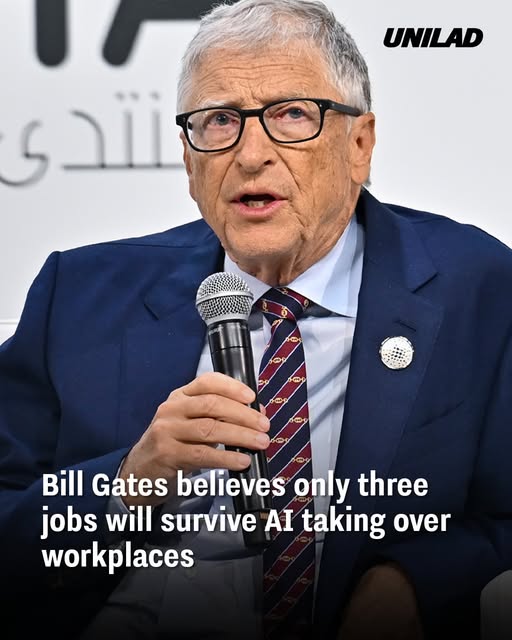
Bill Gates, the co-founder of Microsoft and longtime technology thinker, has frequently discussed how artificial intelligence will reshape the global job market. While AI offers immense potential for productivity and problem-solving, Gates warns it will also disrupt a wide range of professions — making many roles as we know them obsolete while elevating others that depend on uniquely human skills and adaptability.
His perspective comes at a time when AI systems are already performing tasks that previously required human cognition, from writing and editing to data analysis and pattern recognition. As these technologies continue to improve, human workers must be prepared to adapt and focus on the kinds of work machines are less capable of doing themselves.
Jobs Most Threatened by AI
Routine and repetitive jobs are among the first to feel pressure from automation. Roles in retail checkout, manufacturing assembly, basic accounting, and entry-level administrative work are already increasingly automated. Machines excel at predictable, structured tasks, reducing the demand for human labor in these areas. Even fields once thought secure — like customer service — are seeing rapid adoption of AI chatbots and virtual assistants handling tasks previously managed by human staff. Some sectors automate data entry and basic analysis so thoroughly that entire job titles are becoming rare or redefined. According to Gates, this transformation is not limited to blue-collar work. White-collar professions involving repetitive intellectual labor (such as scheduling, writing routine reports, or simple research) are also at risk of being automated in the near future. This creates urgency for workers to rethink their roles and acquire skills that complement, rather than compete with, AI.
Three Fields Gates Believes Will Remain Vital
Despite these concerns, Gates believes there are three broad fields where human involvement will remain essential even as AI advances:
1. Software and AI Systems Development
AI depends on human programmers to build, maintain, and direct its evolution. Skilled developers who design architectures, debug complex systems, and guide strategic technological decisions are likely to remain in demand. Complexity and creative problem-solving in coding and systems architecture are areas where human insight remains crucial.
2. Biological and Life Sciences
Roles in biology and life sciences — including research, biotechnology, and advanced scientific inquiry — require deep human creativity, hypothesis framing, and judgment. While AI can assist with data analysis and pattern detection, human researchers still lead discoveries and interpret nuanced results.
3. Energy and Critical Infrastructure Management
Experts in energy, sustainability, and infrastructure operations manage systems with high stakes and real-world uncertainties. These roles involve understanding ethical, environmental, and safety considerations that go beyond rule-based automation. Decision-making in these areas benefits from human adaptability and judgment. Together, these three fields highlight areas where human creativity, adaptability, and strategic thinking remain in demand — even as machines take on more routine tasks.
Gates’s Broader Vision for AI
For Gates, AI represents both a challenge and an opportunity. He often advocates learning and digital literacy as essential tools for future generations, especially as job markets evolve. Understanding AI doesn’t guarantee employment stability, but it can help workers identify roles that complement automation rather than compete with it. Gates also suggests that AI could improve quality of life by reducing time spent on mundane tasks and freeing humans to pursue creative or socially beneficial activities. In some discussions, he has even mentioned shorter workweeks made possible by productivity gains, although this remains speculative and dependent on economic structures adapting to technological change.
What This Means for Workers
As AI becomes more capable, focusing on skills that machines have difficulty replicating — such as creative reasoning, complex judgment, ethical decision-making, and emotional intelligence — will be increasingly valuable. Professionals and students are encouraged to build adaptability, lifelong learning habits, and interdisciplinary expertise that integrate technical ability with human insight. In this emerging landscape, Gates’s message is clear: embrace technological change, understand where human strengths still matter most, and plan a career path that leverages those irreplaceable qualities.