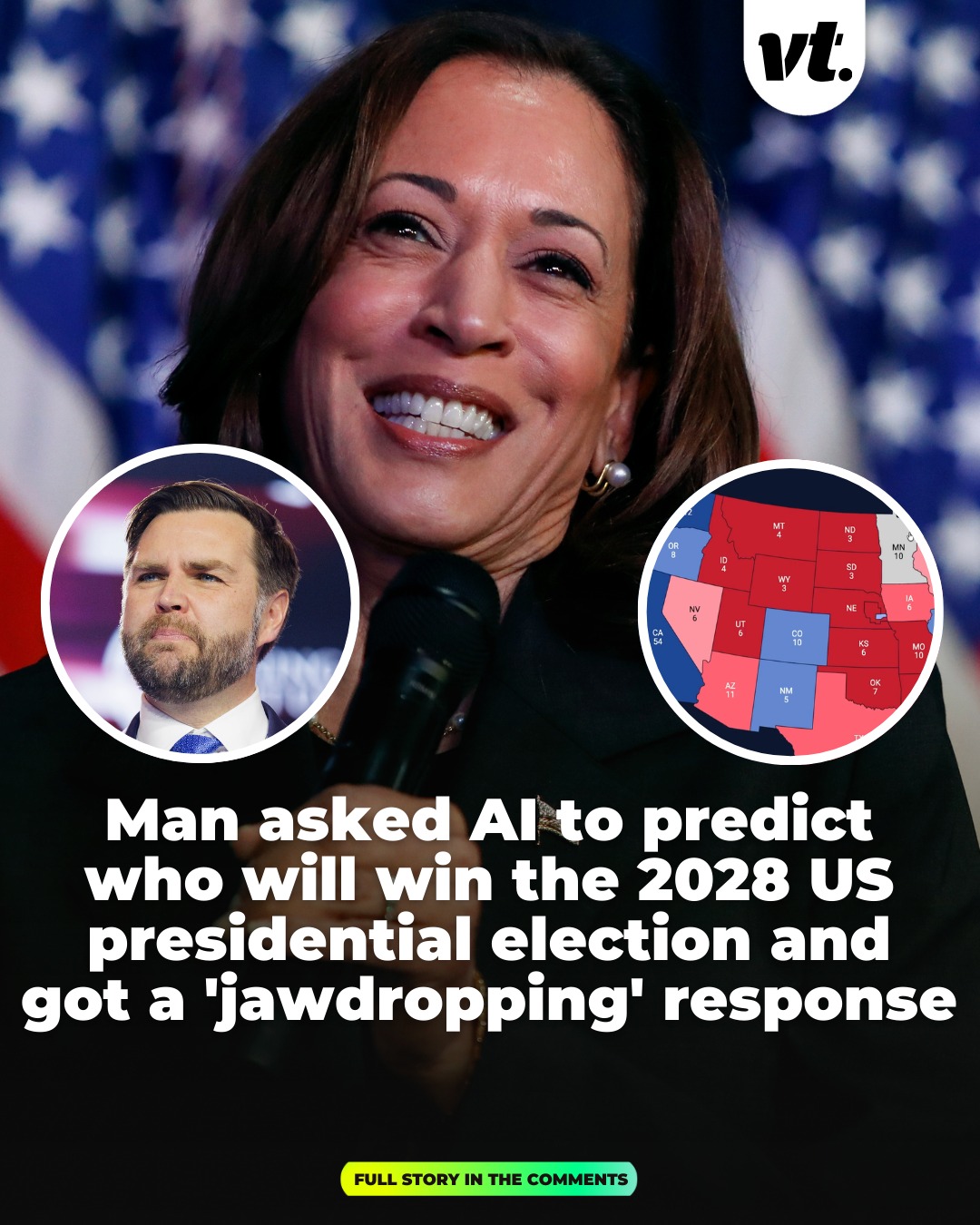
A newly circulated online video shows a dramatic forecast made by Grok, an artificial intelligence bot developed as part of X (formerly Twitter) by Elon Musk’s technology company. In the video, a content creator using Grok fed the AI early polling data, betting odds, and state-by-state projections to ask who might win the 2028 United States presidential election and the result surprised many viewers.
According to the AI’s simulation, Vice President Kamala Harris would emerge as the Democratic nominee and could potentially win the general election against a Republican challenger. On the GOP side, J.D. Vance was identified as the most likely Republican nominee among several contenders. Grok assigned Vance a strong chance of becoming his party’s standard-bearer, reflecting current trends in early polls and prediction markets.
How the AI Model Worked
The creator of the video reportedly input assumed candidate lists and preliminary polling figures into the AI, which then combined that with broader forecasting tools like betting markets and demographic data. Using this information, the AI presented a simulated general-election map indicating which states each candidate would win and by what margins. However, analysts and political experts caution that such AI forecasts should be interpreted carefully. They are not based on definitive voter intentions and do not incorporate all variables that could influence the race as 2028 approaches. Early AI predictions often reflect heavily on the data they receive — meaning they can amplify existing trends without capturing real-world shifts closer to election day.
Predictions vs. Polls and Markets
Outside of AI forecasts, other sources also offer insights into the emerging 2028 landscape. Prediction markets — platforms where traders bet on likely outcomes — currently show J.D. Vance as a leading Republican nominee candidate and Gavin Newsom as a frontrunner on the Democratic side, with significant trading volume backing both names. In these markets, Vance holds notable odds of securing the GOP nomination, while Newsom leads the Democratic nominee market. In the broader general-election odds, Vance continues to carry a plurality of trading support, though this does not necessarily predict voter behavior, which can change significantly near the campaign season.
Broader Political Context
While AI models and prediction markets are generating headlines, actual political dynamics are still forming. Democratic voters are expressing varied preferences in early polls, and a wide range of potential candidates — from established figures like Harris and Newsom to newer voices — may enter the race. Given that official campaign announcements are still years away, much of the speculation around 2028 remains preliminary. Experts stress that early favorites can fade and unexpected candidates may rise, especially as key issues and voter priorities evolve closer to those election cycles.
AI’s Growing Role in Political Forecasting
This latest AI prediction highlights how digital tools are increasingly involved in political discussion. Both AI algorithms and online markets add to the mix of opinion polls, expert commentary, and traditional forecasting models. However, political scientists emphasize that algorithms do not make real decisions — they reflect interpretations of current inputs and historical data, not actual voter intent. As interest in the 2028 election grows, more sophisticated models — whether human or machine-based — will continue to shape early narratives. But voters and analysts alike should remember that predictions made years in advance are not definitive, and real electoral outcomes can vary widely as campaigns unfold.