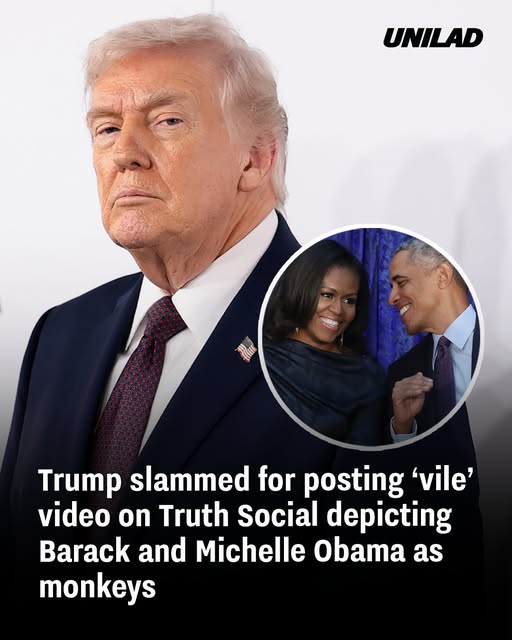
President Donald Trump posted a video on his Truth Social account that briefly showed former President Barack Obama and former First Lady Michelle Obama with their faces superimposed on the bodies of apes. The imagery appears at the end of a longer clip that also included false claims related to the 2020 U.S. election. The post was shared late on February 5, 2026, and remained online for about 12 hours before it was removed amid mounting criticism.
The video drew immediate controversy because comparing Black people to monkeys or apes is widely recognised as a racist and dehumanising trope with a long and harmful history.
Swift Backlash Across the Political Spectrum
Political reaction was overwhelmingly negative and bipartisan:
- Civil rights leaders and Democrats denounced the post as offensive and unacceptable.
- Republican lawmakers — including Senator Tim Scott, the only Black Republican in the U.S. Senate — publicly called for the post to be taken down and criticised the imagery as “the most racist thing I’ve seen out of this White House.”
- Some Republican Senators including Susan Collins, Roger Wicker and others also urged Trump to apologise.
- Even some figures normally supportive of Trump expressed disapproval, illustrating the depth of the backlash among GOP members.
White House Response and Removal of the Post
Initially, the White House defended the post, with Press Secretary Karoline Leavitt describing it as part of an “internet meme” and dismissing criticism as “fake outrage.” Later, the video was deleted from Truth Social and the administration said it had been posted “erroneously” by a staffer. Despite calls for an apology, Trump refused to apologise, saying he didn’t see the offensive portion of the video before it was posted and while he condemned the racist elements, he insisted that he “didn’t make a mistake” by sharing it.
Broader Context and Impact
The incident came during Black History Month, heightening sensitivity to the content and timing of the post. Critics said that even if intended as a meme or satire, the imagery invoked a racist stereotype with deep historical roots, especially when depicting the nation’s first Black president and first lady. The controversy also triggered discussion about the use of AI‑generated content online and how political leaders share such material on official and semi‑official platforms. Observers noted that the video was AI‑generated and that the poorly‑edited illusion underscored the risks of amplifying manipulated media without careful review.
Reactions From the Obamas
There was no official public comment from Barack or Michelle Obama about the incident, though statements from civil rights advocates and Democratic leaders emphasised respect for the Obamas and denounced the depiction.
Political Fallout
The backlash has been significant enough to prompt rare public criticism from members of Trump’s own party — a notable development given typical GOP support for the president’s actions on social media. Some commentators and analysts see this episode as a moment that could influence public perceptions of Trump’s approach to race and political discourse.
Conclusion
The video posted by Donald Trump on Truth Social depicting Barack and Michelle Obama as monkeys sparked widespread condemnation across the political spectrum for its racist and offensive nature. The imagery tapped into a deeply harmful stereotype, provoking outrage not only from Democrats and civil rights leaders but also from prominent Republicans, highlighting the severity of the backlash. Despite initial defenses and the post’s eventual removal, Trump’s refusal to fully apologize has intensified criticism and raised serious questions about the use of AI-generated content and the responsibilities of public figures in shaping discourse. This incident underscores the ongoing tensions surrounding race, politics, and media in America, and marks a rare moment of bipartisan repudiation within Trump’s own party.