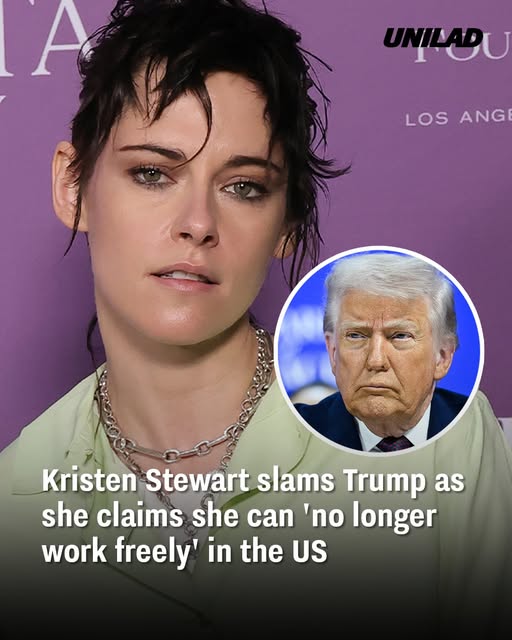
Hollywood actress Kristen Stewart best known for the Twilight films and now an emerging director publicly criticized U.S. President Donald Trump’s controversial approach to the film industry. Stewart described Trump’s proposed tariffs on international movie production as “terrifying” and said the political climate in the United States has made it difficult for her to work freely there.
Her comments came amid discussions of Trump’s America-First film policy, including a plan floated by his administration to impose a 100 % tariff on films produced outside the U.S.. The intention behind this policy, according to Trump and supporters, is to boost domestic production — but many in Hollywood argue it could disrupt global filmmaking and stifle creative freedom.
Stewart Considers Leaving the United States
Stewart revealed she is increasingly thinking about leaving the U.S. due to these industry conditions. She told The Times that she feels she “can’t work freely” under the current political environment and that this has influenced where she chooses to make films. Her directorial debut, The Chronology of Water, was filmed in Latvia — a choice she said was because the project would have been nearly impossible to produce in the U.S. due to both financial and regulatory hurdles. Stewart suggested that she might relocate to Europe to pursue her creative projects and continue building a directing career there. While she emphasized that she doesn’t want to give up on America entirely, Stewart acknowledged it’s “probably not” somewhere she’ll stay long-term if the current policies remain in place.
Trump’s Tariff Proposal and Industry Response
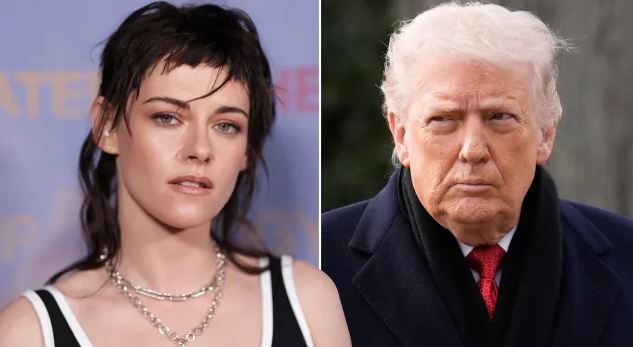
The tariff proposal at the center of the controversy was first announced as part of Donald Trump’s broader economic strategy to protect and expand American film production. The idea — a 100 % tariff on movies produced outside the United States when entered into the U.S. market — has drawn criticism from filmmakers, studios, and political figures alike. Critics say such tariffs could damage Hollywood’s ability to operate globally, as much of contemporary filmmaking relies on cross-border collaboration, tax incentives abroad, and international investment. California’s governor, for example, called the idea “100 % stupid” and warned it could do lasting harm to the U.S. film industry. Supporters of Trump’s stance argue that incentivizing more domestic production could revive jobs and investments in traditional U.S. studio hubs. However, the proposal has not moved forward as a formal law and remains largely a strategic talking point in economic and cultural policy discussions.
Wider Context and Long-Term Impact
Stewart’s remarks reflect broader tensions in the entertainment world about the intersection of art, politics, and economics. Her critique ties into ongoing debates over creative freedom, global collaboration, and how geopolitical policies affect artistic industries. Some industry experts argue that restrictive measures like tariffs could backfire, pushing talent and investment away from the U.S. rather than keeping them at home. Stewart’s potential move to Europe underscores how artists may respond when they feel their creative opportunities are diminished by domestic policy — a sign of how culture and politics increasingly intersect in the global media landscape.
Conclusion
Kristen Stewart’s reaction to Donald Trump’s proposed film tariffs highlights a growing unease within the global entertainment industry. Her comments reflect broader concerns that restrictive, protectionist policies could limit creative freedom, disrupt international collaboration, and push talent away from the United States rather than strengthening its film sector. While the intention behind such measures may be to support domestic production, many filmmakers fear the long-term consequences could be cultural isolation and reduced artistic innovation. Stewart’s willingness to consider working abroad underscores how deeply politics and policy can shape creative choices — and how quickly artists may look elsewhere when they feel their freedom to create is under threat.