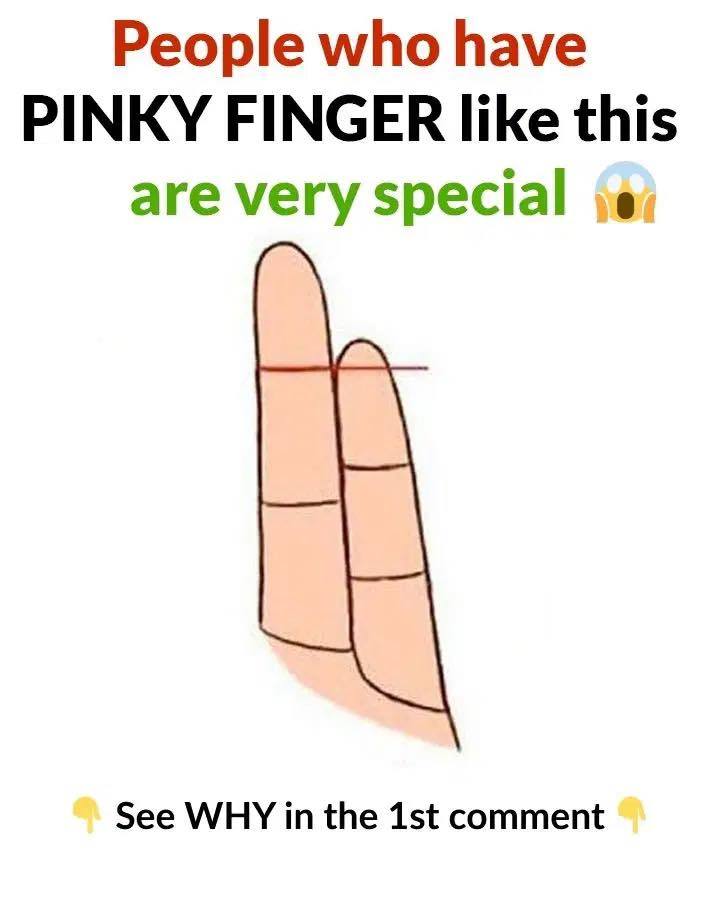
Your pinky finger—also called the little finger—is the smallest finger on your hand. While it might seem like a small detail, the shape, length, or bend of the pinky has long fascinated people. Across cultures and centuries, many have claimed that the pinky can reveal secrets about your personality, communication skills, and even your destiny. But how much of this is true? Let’s separate fact from fiction.
Popular Beliefs and Myths About the Pinky Finger
Online articles and social media often circulate claims about the pinky’s “hidden meanings.” You may have seen headlines like: “People with this kind of pinky are very special” or “Your pinky reveals if you’re a natural leader.” These ideas usually come from palmistry, an ancient practice that tries to interpret your personality by reading the lines and shapes of your hands.
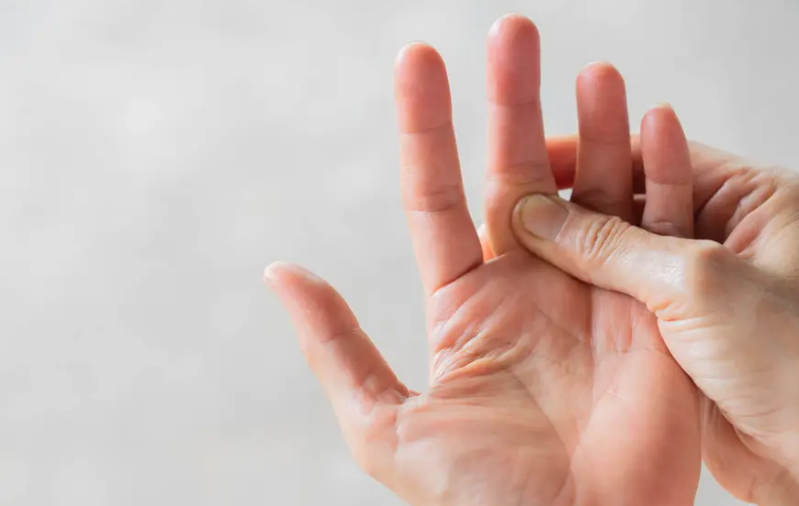
For example, some believe:
- A long pinky finger indicates strong communication skills, confidence, or leadership ability.
- A short pinky suggests shyness or introversion.
- A pinky that curves inward or outward shows diplomacy or independence.
These beliefs come from symbolism connected to the pinky’s association with the Roman god Mercury, who was thought to govern communication and trade. The pinky’s length and shape were interpreted as signs of how well a person could express themselves or succeed in business.
What Science Really Says
While these ideas are interesting and fun to consider, scientific research does not support the notion that finger shape or length determines your personality. The study of personality traits belongs to psychology, which relies on evidence-based methods such as surveys, experiments, and brain imaging—not the shape of fingers.
Why Does Finger Length Vary?
The differences in pinky length and shape are mainly due to genetics. Our DNA influences bone growth, finger length ratios, and joint flexibility. Some people naturally have longer or more curved fingers, and these variations are completely normal. Hand use and activities also affect finger shape over time. For example, people who play instruments or use their hands heavily may develop stronger or differently shaped fingers. There is a scientific field called dermatoglyphics which studies fingerprints and skin ridge patterns for medical or forensic purposes, but this doesn’t connect to personality or abilities.
The Psychological Phenomenon of Seeing Patterns
Part of why people believe in finger-related personality traits is a mental bias called pareidolia — the tendency of our brains to see meaningful patterns (like faces or symbols) where none exist. Humans have evolved to recognize faces quickly, which sometimes leads us to interpret random traits, like finger length, as meaningful signs. The desire to find simple, physical markers of personality is natural — it feels like an easy shortcut to understanding ourselves and others. However, true personality traits are complex and influenced by a mixture of genetics, environment, experience, and choice.

What Should You Take Away From This?
- Your pinky finger’s length or shape is a normal physical variation, not a secret code about who you are.
- Personality and communication skills are much better understood through psychology, education, and life experience.
- While palmistry and similar practices have cultural and historical value, they are not scientifically validated. They are better enjoyed as folklore or entertainment rather than fact.
Final Thoughts
It’s fun to think about what your pinky finger might say about you, but don’t let myths shape how you see yourself or others. Instead, focus on developing your skills, interests, and relationships through learning and real-world experience. Those are the things that truly make you special — not the length of your little finger.